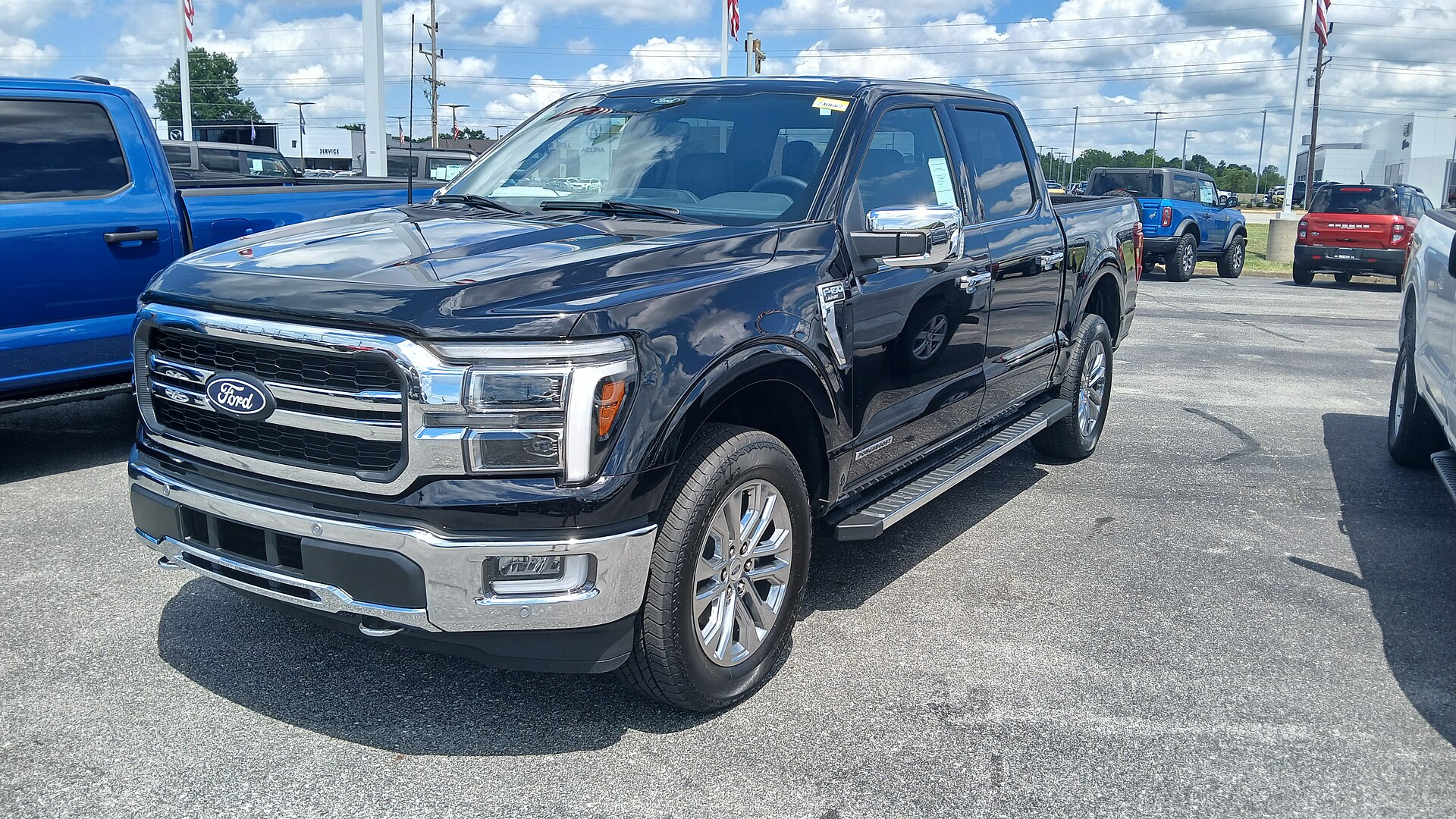
Identity before specification
Collect the VIN, cab and bed codes, engine, axle ratio, drivetrain, wheel and tyre code, tow package, payload label and hitch rating. This step ties the offered unit to a real sales market and stops a brochure from another country becoming false evidence. Primary evidence comes from Ford Motor Company, “Ford F-150 power features”: The manufacturer feature page separates engine and driveline choices that directly affect payload, towing and service requirements.
Market boundary
Maximum brochure figures describe selected configurations; Lightning is a separate battery-electric product and cannot share combustion documents. The comparison sheet should therefore contain separate rows for derivative, body, propulsion, production month and approval number. Primary evidence comes from Ford Motor Company, “2026 Ford F-150 towing guide”: Ford’s configuration tables show why cab, bed, engine, axle, drivetrain and package codes must all be matched.
Variant and powertrain split
Cab-specific IIHS results and VIN recall status should be checked separately; one cab result cannot certify another body. Record the tested organization, variant, equipment and production boundary beside the result instead of presenting a rating as universal. Primary evidence comes from Insurance Institute for Highway Safety, “2026 F-150 extended-cab safety rating”: IIHS independently assesses a specific cab body, making the body-style boundary explicit for safety comparison.
Safety scope
Calculate legal payload and trailer margin from the physical labels, occupants, accessories and destination rules before purchase. Payment control should require matching identifiers across the quotation, vehicle photographs, build record and destination conformity evidence. Primary evidence comes from Insurance Institute for Highway Safety, “2026 F-150 crew-cab safety rating”: The separate crew-cab assessment demonstrates that safety evidence must follow the actual cab configuration.
Document reconciliation
The article’s procurement task is configuration code, payload label and towing arithmetic. A useful supplier response must provide documents that another reviewer can reproduce and verify. Primary evidence comes from National Highway Traffic Safety Administration, “NHTSA VIN Decoder”: The decoder is a direct government reference for checking the manufacturer, model year, plant and encoded vehicle attributes against the physical VIN.
Physical inspection plan
Ford F-150 is treated here as full-size pickup truck family. That category label does not settle trim, dimensions, payload, battery, engine or destination eligibility. Primary evidence comes from National Highway Traffic Safety Administration, “NHTSA Recalls”: The government recall lookup is used to check open safety campaigns by VIN rather than assuming that a model-name search covers the vehicle.
Service and software continuity
The powertrain scope is market-dependent petrol and full-hybrid derivatives; Lightning treated separately. Every energy, charging, emissions or service claim must remain attached to the exact derivative that produced it. Primary evidence comes from United Nations Economic Commission for Europe, “Vehicle Regulations”: UNECE explains the international vehicle-regulation framework and why destination approval must be verified from documents, not inferred from a foreign registration.
Decision rule
An F-150 tow claim is meaningless without cab, bed, engine, axle ratio, drivetrain and towing-package codes. Door and payload labels control the unit. The buyer should treat the VIN, build label and factory type code as the primary identity chain, then record any contradiction in the supplier file. Compare the supplier record with Ford Motor Company ; Ford’s official model page identifies the current trim family and prevents a single headline specification from being assigned to every truck. The F-150 calculation starts with cab, bed, axle and engine codes, then subtracts occupants and accessories from the door-label payload before checking hitch, brake controller and trailer limits. A truck-specific load rehearsal weighs the intended canopy, winch, occupants and cargo, checks tyre and rear-axle limits, confirms trailer tongue mass, verifies brake-controller operation and preserves legal margin below every physical rating. The trailer exercise adds weight-distributing hitch setup, pin load, frontal-area restriction, sway-control state, transmission temperature, integrated scale calibration, spring code, spare-tyre rating, receiver class and rear-bumper limitations.
Frequently asked questions
Which identity document should be requested first Ford F-150?
Start with the VIN, build label, factory model code and original sales-market document. These records must identify the same Ford F-150 before equipment or price is compared.
Can another market’s specification be copied Ford F-150?
No. A specification from another market is only a research lead. Use it only after the derivative, production period and factory identifiers match the offered Ford F-150.
How should safety ratings be used Ford F-150?
Match the rating to its tested body, equipment and production scope, then check recalls by VIN. A rating does not replace destination approval or a physical inspection.
What requires a pause before payment Ford F-150?
Pause before payment when the VIN, derivative, powertrain, sales market or compliance documents conflict, or when the supplier cannot provide dated evidence for a material claim.
What did the research not establish Ford F-150?
This research does not prove the condition, history, exact equipment or destination eligibility of an individual Ford F-150. Those points require unit-specific documents and inspection.
Sources
- 2026 Ford F-150 modelsFord Motor Company · 2026-08-22
- Ford F-150 power featuresFord Motor Company · 2026-08-22
- 2026 Ford F-150 towing guideFord Motor Company · 2026-08-22
- 2026 F-150 extended-cab safety ratingInsurance Institute for Highway Safety · 2026-08-22
- 2026 F-150 crew-cab safety ratingInsurance Institute for Highway Safety · 2026-08-22
- NHTSA VIN DecoderNational Highway Traffic Safety Administration · 2026-08-22
- NHTSA RecallsNational Highway Traffic Safety Administration · 2026-08-22
- Vehicle RegulationsUnited Nations Economic Commission for Europe · 2026-08-22