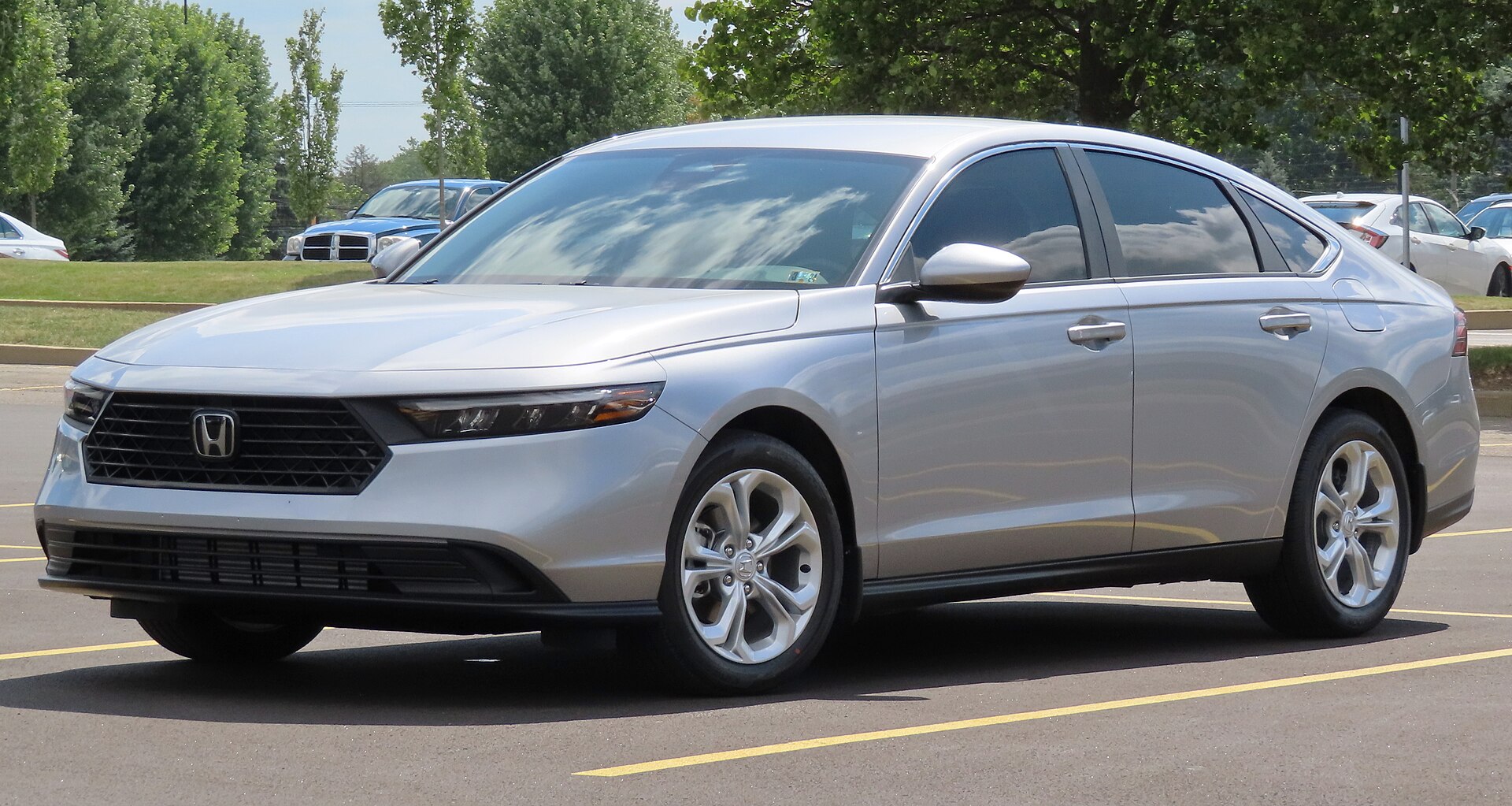
Start with what the 2026 name can prove
The reliable core is narrower than a global-search listing suggests. American Honda publishes a 2026 Accord range of LX, SE, Sport Hybrid, EX-L Hybrid, Sport-L Hybrid and Touring Hybrid. Honda Canada publishes a separate 2026 sheet for SE, Sport-L Hybrid and Touring Hybrid. Both sources describe four-door, front-drive sedans, but their grade menus and equipment are not identical. The seller must therefore identify the original market before a brochure figure becomes relevant to the offered car.
The cited Thailand page and Middle East brochure are useful comparisons, not proof of a 2026 vehicle in those markets. Thailand currently shows three e:HEV grades and the regional Gulf brochure shows turbo gasoline beside e:HEV, yet neither source assigns the 2026 model year. An invoice that merely says “Accord 2026” cannot fill that gap. Ask for the build label, model code, original registration documents and a market-specific factory or dealer equipment record.
Keep each powertrain inside its market boundary
In the United States, the 2026 LX and SE use a 1,498 cc turbocharged four-cylinder rated by Honda at 192 hp with a CVT. The four hybrid grades combine a 1,993 cc Atkinson-cycle engine with a two-motor system rated at 204 total system hp and use a direct-drive unit. Canada's sheet gives the same headline output categories but offers only one turbo grade and two hybrid grades. These are manufacturer figures under North American definitions, not a promise for an unrelated export-market car.
Honda Thailand lists a 1,993 cc e:HEV with 207 PS total system output and E-CVT, while the Middle East brochure lists a 1.5-liter turbo and a 2.0-liter e:HEV with its own figures. Even when displacements look familiar, output units, calibrations, fuel rules and equipment can differ. The hybrid is a self-charging gasoline-electric HEV, not a plug-in or battery EV. Never combine Thai output, Gulf equipment and U.S. economy data into a nonexistent global trim.
Create a vehicle identity pack before valuing the offer
Obtain an unmasked full-VIN photograph, door-jamb production and compliance labels, model or type code, build month, original sales invoice or registration market, and an equipment list tied to that VIN. The binding quotation should repeat the VIN, powertrain, grade, color, mileage, title status and every material option. A generic VIN decoder may indicate assembly or engine family but cannot reliably prove every installed driver-assistance feature, audio unit, lamp or regional software service.
Commission a condition inspection that records cold start, warning lamps, diagnostic trouble codes, odometer, paint depth, structural repairs, flood or corrosion evidence, tire dates, glass and lamp markings, underbody, both keys and charging-port absence or presence. For a hybrid, include battery cooling passages and hybrid-system fault history. Match photographs to the documents and make discrepancies a written rejection condition before the deposit becomes non-refundable.
Read safety results as scoped evidence, not a passport
IIHS tested named 2023 U.S. Accord configurations and states that several crashworthiness results apply to 2023-2026 models. That is valuable evidence for the covered U.S. design, but it does not automatically describe a Thai, Japanese, Canadian or Gulf vehicle's airbags, headlights, sensors or calibration. JNCAP's FY2025 Japanese Accord result and ASEAN NCAP's 2024 Southeast Asian report concern their own test vehicles and protocols. Their scores cannot be averaged or transferred to an unseen unit.
Destination registration is another question entirely. Confirm steering side, headlamp beam, rear fog lamp, speedometer units, emissions and noise labels, glazing, tires, child-restraint anchors, immobilizer and mandatory assistance systems with the importing authority. Search recalls live by VIN in the source jurisdiction immediately before payment and again before shipment. A clean model-name search is not proof that campaigns for that particular VIN were completed.
Test the service plan across the border
Before buying, send the VIN and model code to a Honda-authorized or competent independent repairer at the destination. Ask whether filters, brake components, body panels, lamps, cameras, radar units and hybrid cooling parts can be ordered, and whether the workshop can perform software updates, diagnostic routines and sensor calibration. A mechanically similar Accord may still use market-specific part numbers, security access or infotainment firmware.
Obtain the maintenance schedule, fluid specifications, service history and written warranty terms for the source-market car. Do not assume that a U.S., Canadian, Thai or Gulf warranty follows a privately exported vehicle. Confirm in writing whether roadside assistance, map data, emergency calling, remote applications, radio frequencies, embedded connectivity and recall remedies will function or be supported after export. Price unsupported features at zero rather than treating them as guaranteed benefits.
Convert the sales pitch into a controlled landed cost
Build a dated cost sheet in one comparison currency. Separate vehicle price, source tax treatment, inspection, inland transport, export registration or title work, terminal handling, ocean freight, insurance, destination duty and tax, port storage, broker fees, homologation, required conversions, registration and initial service. Keep exchange-rate assumptions and contingency visible. No source reviewed here supports a current selling price, stock promise, shipping rate or destination tax calculation.
The purchase contract should define the Incoterm, handover point, risk transfer, insurance, document deadline and remedy if the VIN, condition or eligibility fails. Make payment conditional on identity matching, exportable title, acceptable inspection, recall evidence and written pre-clearance against destination rules. Compare the resulting total with a locally supported sedan only after these conditions are priced; a low headline quote cannot compensate for an unregistrable or unsupported car.
Frequently asked questions
Is every 2026 Honda Accord sold with the same engine and trim list?
No. The official U.S. and Canadian 2026 ranges already have different grade menus, and current Thailand and Middle East pages show other combinations without proving a 2026 label. Match the VIN to its original market.
Does an Accord e:HEV or Hybrid need to be plugged in?
No. The cited Accord hybrid is a gasoline-electric HEV that manages charging through its engine and regenerative braking. It is neither a plug-in hybrid nor a battery-electric vehicle.
Can an IIHS, JNCAP or ASEAN NCAP result prove import approval?
No. Each program evaluates specified vehicles under its own protocol. Destination emissions, equipment, conformity and registration rules are separate and must be checked for the offered configuration.
What documents should be obtained before paying a deposit?
Require the full VIN image, production and compliance labels, model code, build date, source-market title or registration, VIN-linked equipment list, service history and a quotation that repeats the same identity.
Can a seller confirm that there are no recalls by quoting the model year?
No. Recall inclusion and repair completion can depend on VIN, production range and equipment. Run the official source-market VIN lookup and retain dated proof of completed remedies before shipment.
Sources
- 2026 Accord Sedan Features & SpecsAmerican Honda Motor Co. · 2026-07-22
- 2026 Honda Accord SpecificationsHonda Canada Inc. · 2026-07-22
- Accord e:HEV technical specificationsHonda Automobile (Thailand) Co., Ltd. · 2026-07-22
- All-New Honda Accord regional brochureHonda Motor Co. Middle East · 2026-07-22
- 2025 Honda Accord 4-door sedan ratingsInsurance Institute for Highway Safety · 2026-07-22
- ACCORD Vehicle Safety Performance 2025National Agency for Automotive Safety and Victims' Aid (NASVA/JNCAP) · 2026-07-22
- Honda Accord (2024) Digital Report V1.1ASEAN NCAP · 2026-07-22
- Check for Recalls: Vehicle, Car Seat, Tire, EquipmentNational Highway Traffic Safety Administration · 2026-07-22
- Stay informed about recalls of vehicles, tires and child car seatsTransport Canada · 2026-07-22