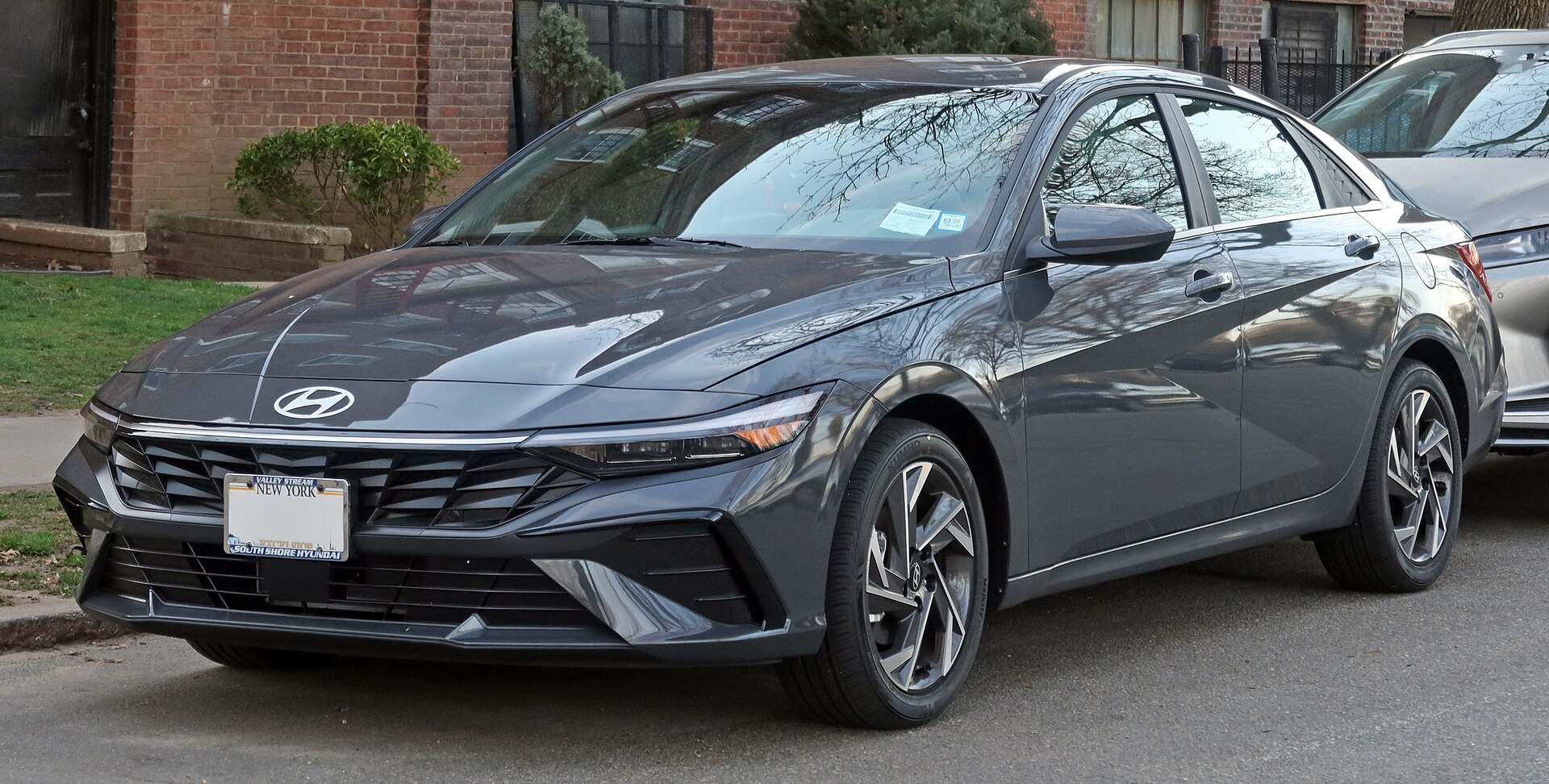
The badge is not the specification
A 2026 Elantra is real and documented, but the reliable boundary is narrower than the word global suggests. Hyundai Motor America and Hyundai Auto Canada each publish a 2026 range. That evidence supports U.S.- and Canada-market cars; it does not automatically describe an Elantra sold elsewhere, nor a Hyundai carrying the Avante or i30 Sedan name. An export offer should begin with the original market, VIN, trim code and production label rather than a translated model name.
This distinction matters because the same body family can carry different engines, driver-assistance packages, lighting, labels and certification documents. A seller's phrase such as full option or global version is not a homologation category. Ask for the original window sticker or Canadian build sheet, clear photographs of the certification and emissions labels, and a VIN decode from the relevant manufacturer or authority before matching the car to a destination rulebook.
Three Canadian powertrain paths, not one blended Elantra
Hyundai Canada gives the clearest 2026 comparison: a 147 hp 2.0-litre Atkinson-cycle four-cylinder with an intelligent variable transmission, a 201 hp 1.6-litre turbo with a seven-speed dual-clutch transmission for N Line, and a 139 hp 1.6-litre hybrid with a 32 kW motor and six-speed EcoShift dual-clutch transmission. These are alternatives tied to trims. Combining the strongest output, lowest consumption and richest equipment into one imaginary specification would misdescribe the vehicle.
For a buyer, the powertrain choice changes more than performance. The hybrid adds a high-voltage system and multi-link rear suspension in the Canadian product card; the N Line has its own turbo engine, transmission and sport hardware. Record the engine code, transmission, fuel label and under-hood identifiers. Confirm that the destination has diagnostic access, trained service and parts for that exact system, especially before sending a hybrid far from Hyundai's intended retail network.
Keep U.S. and Canadian efficiency evidence in separate lanes
For the United States, Hyundai lists the 2026 gasoline SE at an EPA-estimated 31 mpg city, 40 highway and 35 combined. The U.S. Hybrid Blue is listed at 51/58/54 mpg, while SEL Sport and Limited hybrids are listed at 49/52/50. Those are trim-specific U.S. comparison values, not promises of real-world economy and not certification results for another country. Wheel choice, climate, load, fuel and driving conditions can change actual consumption.
Hyundai Canada instead cites 4.7 L/100 km combined and an estimated range up to 893 km for its Luxury Hybrid, calculated with a 42-litre tank. Preserve that wording and test context rather than converting whichever number looks most attractive. For landed-cost planning, request the exact trim's official label and build sheet, then estimate fuel locally using the buyer's route, temperature, traffic and fuel quality. No source here establishes a universal Elantra efficiency figure.
Read the safety award with its test genealogy
IIHS lists the 2026 Elantra as a Top Safety Pick and shows Good ratings for small overlap, updated moderate overlap, updated side impact, headlights and pedestrian front-crash prevention. The detail is more useful than the badge: the small-overlap results apply from a 2021 test vehicle, the updated side result from a 2024 vehicle, and the updated moderate-overlap result from a 2025 vehicle for 2025-2026 cars built after October 2024. The page also rates seat-belt reminders and LATCH ease as Acceptable.
That genealogy does not invalidate the award, but it limits what an exporter should infer. It is an evaluation of applicable U.S. model configurations and design continuities, not an inspection of the car being offered. Check the build date, restraint labels, airbag warning lamps, crash history and repair records. Confirm that safety hardware has not been removed or substituted and that driver-assistance sensors can be calibrated at the destination after glass, bumper or body work.
Two recall gates require a VIN, not reassurance
NHTSA campaign 26V254 includes certain 2026 U.S. Elantras whose B-pillar side-impact sensors may have been misassembled, potentially delaying airbag deployment. The stated remedy is dealer inspection and replacement where necessary. Transport Canada recall 2026235 covers certain 2024-2026 Elantra hybrids whose hybrid power control unit may overheat, cause a no-start or reduced-power condition, and create a fire risk; the stated correction is an HPCU software update.
Neither notice means every Elantra is affected, and neither can be cleared by model year alone. Before payment, run the full VIN through the authority for the vehicle's original market and obtain dated completion evidence for every open campaign. Recheck immediately before shipment because recall databases evolve. If a remedy is unavailable to an overseas owner, complete it inside the original service network and retain the repair order; a seller's screenshot without the VIN and lookup date is weak evidence.
Build an Elantra-specific export file before pricing freight
A useful purchase file should contain the VIN, production month, original market, trim, engine and transmission codes, title status, odometer evidence, service history, collision inspection and recall results. For the hybrid, add battery diagnostic information, high-voltage warning checks and the carrier's acceptance conditions. Use the Canadian dimensions only as an early planning reference; ask for actual curb mass, ground clearance and measured shipping dimensions from the specific car and its documents.
Then test destination fit: emissions and noise evidence, lamp pattern, speedometer units, language labels, immobilizer, radio and connected-service compatibility, parts channels and technician capability. Obtain written import and registration guidance from the destination authority or a qualified local specialist. Quote vehicle price, inland movement, freight, insurance, duty, tax, inspection and remedial work separately. This process cannot promise approval, but it exposes the exact gaps that a low headline price tends to hide.
Frequently asked questions
Is there an officially documented 2026 Hyundai Elantra?
Yes. Hyundai Motor America and Hyundai Auto Canada both publish 2026 Elantra material. That confirms the model year in those two markets only; it does not establish the same name, trim range or certification in every destination country.
Are all 2026 Elantras equipped with the same engine and transmission?
No. Canada's range alone includes a 2.0-litre gasoline engine with IVT, a 1.6-litre turbo with seven-speed DCT and a 1.6-litre hybrid with six-speed DCT. The VIN and original build sheet must identify the offered car.
Does the Elantra Hybrid need external charging?
No. Hyundai's U.S. material identifies it as a non-plug-in hybrid whose battery is replenished by the engine and regenerative braking. Charging behavior does not remove the need for destination-side high-voltage service and shipping checks.
Does the IIHS Top Safety Pick mean any export example is cleared?
No. The award is valuable U.S. safety evidence, but the IIHS page uses tests from several applicable model years and notes a build-date boundary. It cannot confirm an individual car's damage history, equipment, recall status or local legal compliance.
What should be verified before paying for a cross-border Elantra?
Verify the full VIN, original market, build date, trim, powertrain, title, odometer, condition and service history. Run original-market recall checks, secure remedy records, and obtain written destination guidance on import, emissions, lighting and registration.
Sources
- 2026 Hyundai ElantraHyundai Motor America · 2026-07-22
- 2026 Hyundai Elantra HybridHyundai Motor America · 2026-07-22
- 2026 Hyundai ELANTRA: Compact CarHyundai Auto Canada Corp. · 2026-07-22
- 2026 ELANTRA Product CardHyundai Auto Canada Corp. · 2026-07-22
- The new ELANTRA HighlightsHyundai Motor Company · 2026-07-22
- 2026 Hyundai ElantraInsurance Institute for Highway Safety · 2026-07-22
- NHTSA Safety Recall 26V254: Misassembled Air Bag SensorsU.S. National Highway Traffic Safety Administration · 2026-07-22
- Transport Canada Recall 2026235 - HYUNDAITransport Canada · 2026-07-22