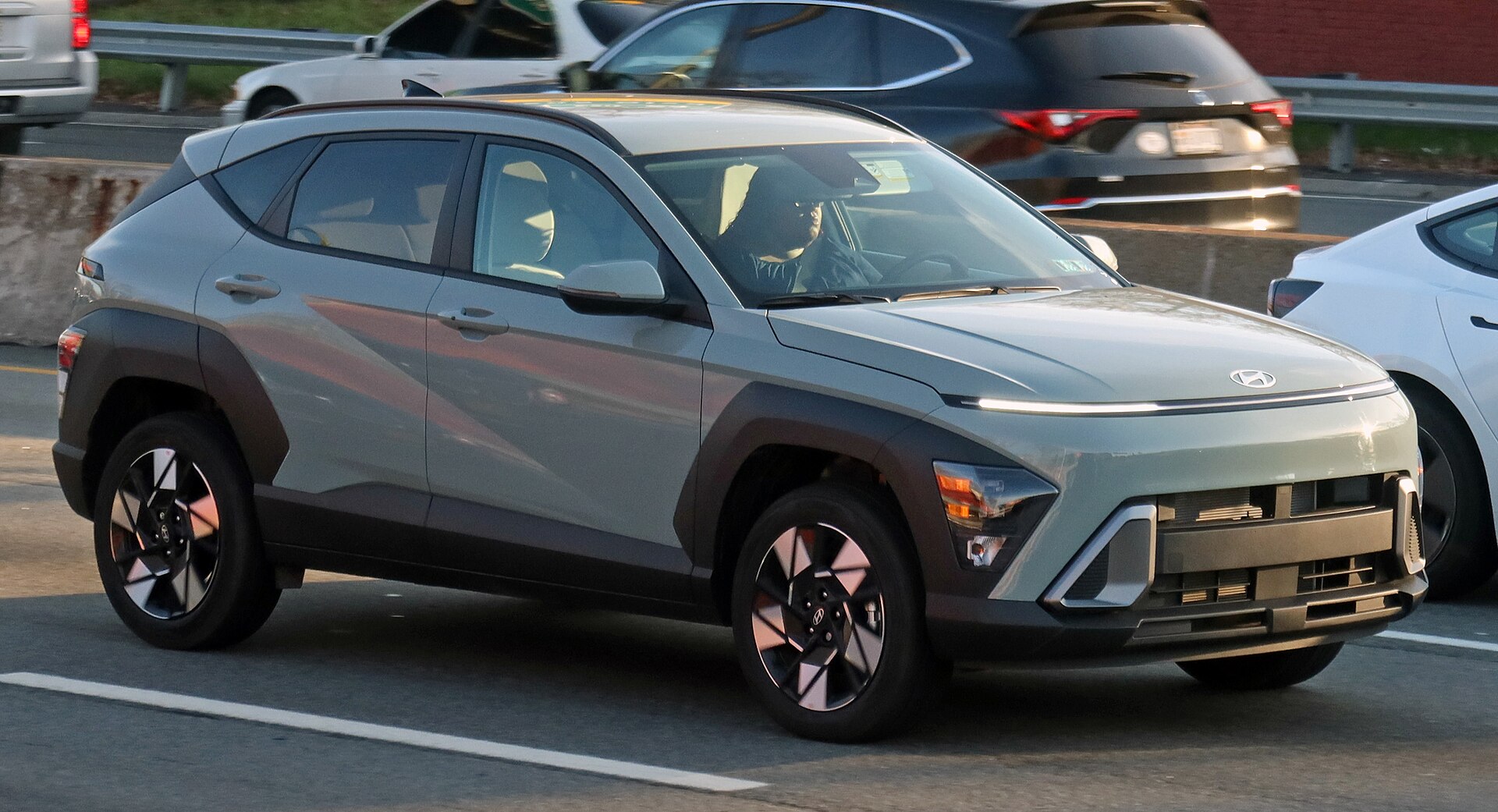
First prove which KONA is being offered
The phrase “2026 Hyundai KONA” has a firm anchor in the United States: Hyundai Motor America publishes a 2026 gasoline range. It is not a safe global shorthand. The current UK page spans petrol, hybrid and electric models, Hyundai Korea separates those families on its local site, and the Australian manufacturer document reviewed here is labeled 2025. An exporter should record the source market, model-year evidence and variant name before comparing any specification.
Ask for the VIN, build month, market-specific order code, registration or title, conformity label and an unedited photograph of the under-hood or charging information. Match those items to the seller's invoice and the official market brochure. A badge, translated advertisement or dashboard screenshot cannot establish model year. If the paperwork names KONA Electric or Hybrid, do not fill missing fields from a U.S. gasoline table simply because the exterior generation looks similar.
Map the powertrain without crossing borders
For the U.S. 2026 model, Hyundai lists a 147-hp 2.0-liter MPI Atkinson-cycle four-cylinder with an intelligent variable transmission, and a 190-hp 1.6-liter turbo GDI four-cylinder with an eight-speed automatic. Front-wheel drive is standard and HTRAC all-wheel drive is available across the gasoline trims. Those facts create a useful U.S. decoding check, but they say nothing about a UK hybrid battery, a Korean trim package or an Australian-market calibration.
Hyundai's UK material currently presents petrol, self-charging hybrid and battery-electric KONA variants, while the Korean site links gasoline, Hybrid and Electric lines with its own local equipment. The global launch release also describes two KONA Electric battery sizes using European reference specifications. Treat each combination as a separate vehicle family for procurement: record fuel, engine or motor code, battery identifier where relevant, transmission, driven wheels, charging inlet and stated homologation market.
Use dimensions as identification clues, not universal promises
The U.S. 2026 gasoline specification gives a 171.3-inch length, 71.9-inch width and 104.7-inch wheelbase. Hyundai's 2023 global KONA Electric introduction gives 4,355 mm by 1,825 mm with a 2,660 mm wheelbase for the standard EV body, and separately notes a longer N Line figure. The close numbers help identify the second-generation shape, yet bumper design, ride height, wheel size, underbody equipment and cargo measurement standards can still change the shipping calculation.
For freight planning, obtain an actual dimension and mass sheet tied to the chosen VIN or exact variant. Confirm curb and gross vehicle mass, roof accessories, tire size, ground clearance and whether the mirrors can fold for the carrier. For an electric unit, record state of charge and dangerous-goods documentation; for a gasoline or hybrid unit, obtain the carrier's fuel-level rule. Never quote a container fit or payload from a launch-release dimension alone.
Read safety results inside their test boundaries
IIHS identifies the 2026 KONA as a U.S. Top Safety Pick+, but its page also explains that several ratings come from tests of 2024 vehicles and apply to 2024-2026 models. Euro NCAP assessed a left-hand-drive KONA Electric under its 2023 protocol, and ANCAP publishes a separate assessment for the generation sold in Australia and New Zealand. These programs answer different questions; their labels should be reported alongside the test year, variant and region rather than averaged into one global score.
The detailed reports matter more than a headline. Euro NCAP records strong areas as well as weaker chest, belt and vulnerable-road-user findings, while ANCAP provides category scores and an applicability statement. Equipment such as autonomous emergency braking, blind-spot aids or rear braking can vary by trim and software. Verify the physical sensors, menu screens and build specification of the vehicle, and do not represent a driver-assistance feature as autonomous driving or a substitute for an attentive driver.
Put recall and compliance checks ahead of payment
NHTSA filed two relevant U.S. reports in 2026. Recall 26V069 covers certain gasoline KONA vehicles from specified production dates for front steering-knuckle inspection and possible replacement; 26V047 includes certain KONA vehicles in an instrument-cluster display software campaign. Neither filing means every 2026 KONA is affected. Request a current VIN result, dealer repair record and dated proof that any required remedy is complete, then repeat the search immediately before shipment.
A clear U.S. recall result still does not establish import approval elsewhere. The destination authority may require emissions or electric-safety evidence, compliant lamps and glazing, speedometer units, radio certification, cybersecurity documentation or a local type-approval match. Connected navigation, emergency calling, digital keys and phone applications may lose functions outside the selling region. Secure written eligibility from the destination regulator or qualified homologation specialist before making a non-refundable commitment.
Build a landed-cost file around the actual VIN
No reviewed source proves export stock or an export price. A defensible quote should identify seller and title chain, exact vehicle price, inspection, inland movement, port handling, ocean freight, insurance, duties, taxes, homologation work, registration and a contingency for storage or remedy delays. Keep currencies and quote dates visible. Manufacturer retail offers, tax incentives and warranties belong to their home markets unless the responsible provider confirms transferability in writing.
Inspect the KONA for collision or flood history, tire age, glass and lamp markings, diagnostic faults, software campaigns, both keys, charging cable where applicable and documented service. Battery-electric buyers need a battery-health report and compatible charging plan; hybrid and gasoline buyers need emissions and fuel-system confirmation. The sensible purchase is not the listing with the broadest feature claims, but the unit whose identity, condition, compliance path and total cost remain supported by documents.
Frequently asked questions
Is every Hyundai KONA advertised in 2026 a 2026 model-year vehicle?
No. Hyundai's U.S. page explicitly names a 2026 gasoline KONA, but other markets use their own model-year and registration conventions. Verify the VIN, build label, title and official source-market documentation instead of relying on the advertisement date.
Can I choose gasoline, hybrid or electric in every source market?
No common worldwide menu is established. The reviewed U.S. 2026 page is a gasoline range, while current UK and Korean sites present separate electrified KONA families. Confirm the exact locally sold variant and never transfer one market's specification to another.
Does the IIHS award replace Euro NCAP or ANCAP evidence?
No. Each program uses its own protocol, vehicle selection and applicability rules. Preserve the program, test year, variant and market with any safety statement, then confirm that the candidate VIN has the equipment assumed by that assessment.
Do the cited U.S. recalls affect every 2026 KONA?
No. The filings define particular U.S. populations, production periods and remedies. A buyer needs a current VIN-specific result and repair evidence; a model-name match alone cannot show whether a campaign applies or has been completed.
What should be confirmed before paying an exporter?
Confirm vehicle identity and title, seller authority, condition, current recall status, destination eligibility, exact equipment, transport method, insurance, taxes and a line-by-line landed cost. Warranty and connected-service operation should also be confirmed in writing.
Sources
- 2026 KONA vehicle overview and specificationsHyundai Motor America · 2026-07-22
- Hyundai KONA current UK model pageHyundai Motor UK · 2026-07-22
- KONA current Korean-market price and equipment pageHyundai Motor Company Korea · 2026-07-22
- Hyundai KONA 2025 Australian brochureHyundai Motor Company Australia · 2026-07-22
- All-new KONA global technical introductionHyundai Motor Company · 2026-07-22
- 2026 Hyundai KONA safety ratingInsurance Institute for Highway Safety · 2026-07-22
- 2023 Hyundai KONA assessmentEuro NCAP · 2026-07-22
- Hyundai KONA June 2023 onward safety assessmentANCAP Safety · 2026-07-22
- Part 573 Safety Recall Report 26V069U.S. National Highway Traffic Safety Administration · 2026-07-22
- Part 573 Safety Recall Report 26V047U.S. National Highway Traffic Safety Administration · 2026-07-22