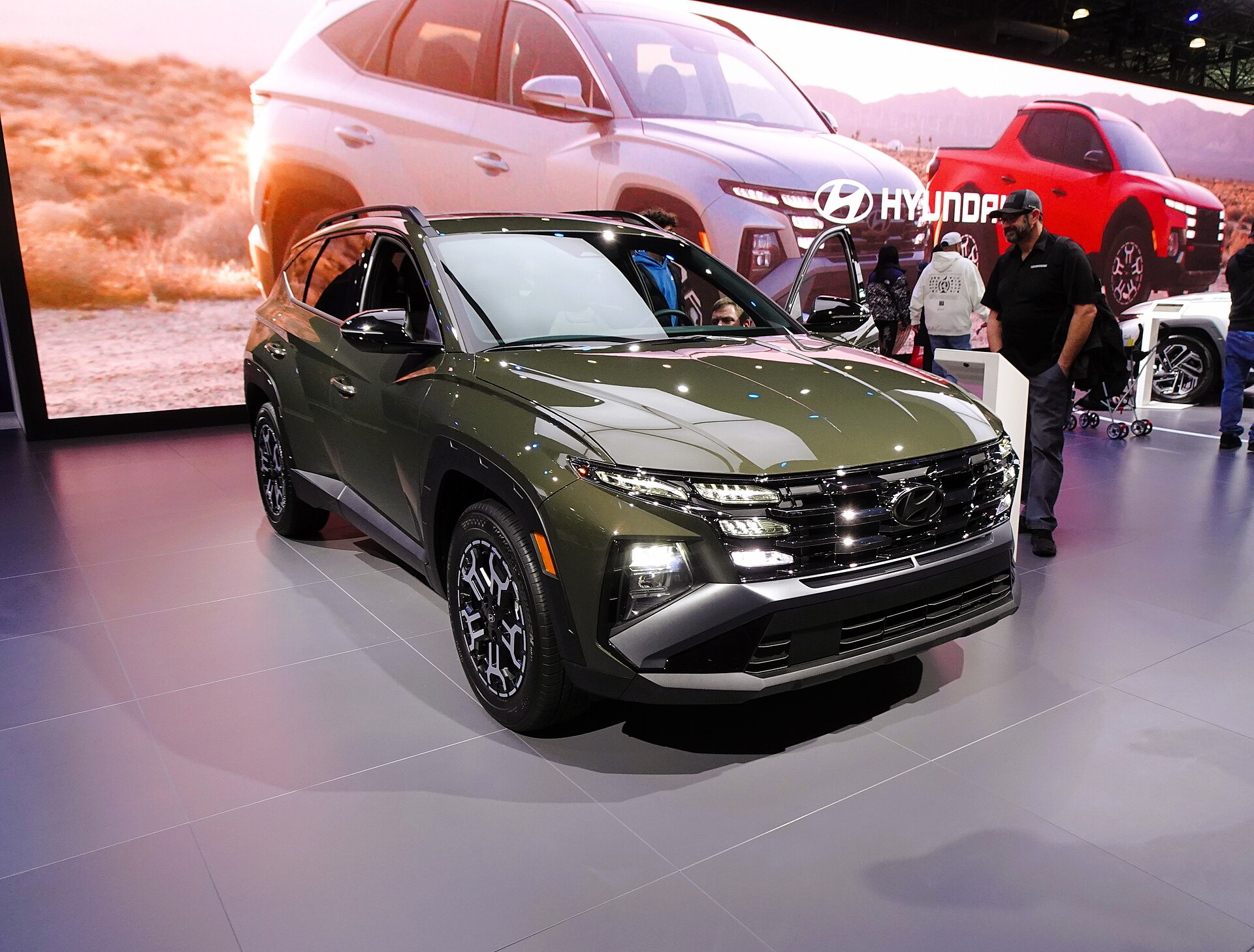
Begin with identity, because TUCSON is a family rather than one specification
Hyundai Motor America explicitly presents gasoline, hybrid and plug-in hybrid TUCSON variants for the 2026 model year. The company calls them carry-over models, but that does not make them mechanically interchangeable. The gasoline model uses a 2.5-liter engine, the hybrid combines a 1.6-liter turbo engine with a small traction battery, and the plug-in hybrid adds a larger rechargeable battery and charge inlet. Before comparing a listing, obtain the complete 17-character VIN, build month, original Monroney label, certification label, title, seller identity and photographs that show the powertrain and charging hardware. Match every document to the same vehicle. A listing date, exterior badge or translated sales sheet cannot prove model year, source market or exact trim.
Country names matter as much as trim names. Hyundai Canada advertises its own 2026 lineup and towing language, while Hyundai Motor UK's current TUCSON page uses different engines, trims, prices and finance terms. Those pages are useful evidence that the model changes across borders, not permission to fill gaps in a U.S. file. If the seller cannot supply an official U.S. window label or an equivalent manufacturer record tied to the VIN, leave unknown fields blank until Hyundai or a qualified inspector confirms them.
Separate the gasoline, hybrid and plug-in hybrid purchase cases
The U.S. gasoline TUCSON is rated at 187 hp and 178 lb-ft from a 2.5-liter GDI/MPI four-cylinder paired with an eight-speed automatic; front-wheel drive is offered and HTRAC all-wheel drive is available. The hybrid uses a 1.6-liter turbo engine, electric motor, 1.49-kWh battery and six-speed automatic for 231 combined hp and 271 lb-ft, with AWD standard. The PHEV keeps a 1.6-liter turbo architecture but uses a 13.8-kWh rechargeable battery and stronger motor for 268 combined hp, also with a six-speed automatic and standard AWD. Treat these as three separate procurement records, including engine or motor code, battery serial information, driven wheels and service parts.
The distinction changes risk. A gasoline buyer needs destination emissions acceptance and fuel-system service support. A hybrid buyer needs a battery-health scan even though the car is not plugged in. A PHEV buyer also needs charge-port photographs, the supplied cable specification, grid compatibility, a charging test and confirmation that local technicians can support the high-voltage system. Hyundai's 2026 change notice says the PHEV charging cable became a Level 1/Level 2 combination, but the actual cable in a used vehicle must still be inventoried rather than assumed.
Read dimensions, economy and towing figures as labelled evidence
Hyundai's U.S. tables publish a 182.7-inch length, 73.4-inch width excluding mirrors and 108.5-inch wheelbase. Those dimensions help identify the generation, but freight planning needs the exact curb weight, gross rating, height, ground clearance, wheel and roof equipment for the chosen trim. Gasoline curb weights span different FWD and AWD values; the PHEV is substantially heavier. Ask the carrier to approve the VIN-specific dimensions and mass, fuel or state-of-charge rule, dangerous-goods paperwork where required, tie-down method and whether accessories must be removed.
The U.S. gasoline estimates are 25/33/28 mpg for FWD and 24/30/26 for AWD. The Hybrid Blue SE is shown at 38/38/38, while other cited hybrid trims are 36/37/36. The PHEV is shown with 35 mpg in gasoline operation and a 32-mile electric-range estimate, but current Hyundai pages have displayed both 77 and 80 combined MPGe. Do not choose whichever number improves the advertisement. Preserve a dated screenshot, read the VIN-specific window label and describe all estimates as comparative. The 2026 U.S. change notice also raises properly equipped gasoline towing to 2,750 lb while HEV and PHEV remain 2,000 lb; Canadian material publishes a different gasoline figure, so towing must never be globalized.
Use the safety award with its less flattering details
IIHS names the 2026 TUCSON a Top Safety Pick+, but the underlying page is more useful than the badge. Small-overlap results come from 2022 tests, the updated moderate-overlap rating applies to 2024-2026 vehicles built after March 2024, and headlight performance differs by trim. The page gives the Limited projector lamps a good rating and listed reflector lamps an acceptable rating. It also rates the tested power synthetic-leather seat poor for whiplash prevention. A buyer should record these boundaries instead of presenting the award as proof that every component, trim and build date achieved the same result.
IIHS reports good performance for its 2026 vehicle-to-vehicle and pedestrian crash-prevention evaluations, but driver assistance is not autonomous driving and may depend on sensors, software and calibration. Inspect the windshield-camera area, radar and bumper repairs; scan diagnostic modules; verify the installed lamp type; and confirm that no collision repair has altered alignment. Safety ratings do not establish legal importability, lighting compliance or type approval in the destination country.
Run recall checks twice and retain proof of the remedy
NHTSA report 26V047 covers defined U.S. production groups, including certain 2026 gasoline TUCSON vehicles and 2025-2026 HEV and PHEV vehicles, for an instrument-cluster display software problem. Report 26V316 covers certain 2025-2026 gasoline, HEV and PHEV vehicles whose forward-collision-avoidance software may brake earlier than expected. Report 26V400 describes another defined 2025-2026 gasoline population whose instrument panel can reboot and temporarily blank essential information. The reports overlap model names but differ in defect, production period and population.
None of those reports proves that an advertised vehicle is affected, unaffected or repaired. Search NHTSA with the exact VIN, request Hyundai dealer campaign history and collect the repair order or OTA completion record. Repeat the lookup immediately before payment or shipment because campaigns and remedy status change. If a recall is open, obtain written confirmation that a U.S. dealer can complete it before export; a destination dealer may not be authorized or equipped to perform a U.S. campaign.
Price the compliance path, not merely the car
Hyundai's displayed U.S. MSRP excludes freight, tax, title and license, while actual dealer prices and optional equipment vary. Canadian and UK figures use different currencies, taxes, incentives and finance conditions. None is an export quotation. Build a landed-cost worksheet that identifies the exact vehicle price, title and lien clearance, independent inspection, inland transport, port charges, ocean freight, insurance, duties, value-added or sales tax, broker fees, storage, homologation work, charging equipment, registration and a contingency for delayed repairs. Date every quote and keep the currency and Incoterm visible.
Before a non-refundable payment, verify seller authority, title chain, odometer and damage history, flood or collision evidence, both keys, manuals, diagnostic scan, tire and glass markings, service history and all promised accessories. Confirm destination rules for emissions, lamps, glazing, speed units, radio certification, emergency calling, cybersecurity and high-voltage documentation. Hyundai's U.S. warranty handbook contains coverage that depends on parts, time, mileage and registration conditions; do not promise transfer after export without written confirmation. The best purchase is the VIN whose identity, condition, recall status, compliance route and total cost remain auditable.
Frequently asked questions
Is every 2026 Hyundai TUCSON mechanically the same?
No. The U.S. range includes a 2.5-liter gasoline model, a 231-hp hybrid and a 268-hp plug-in hybrid, with different batteries, drivetrains, weights and economy labels. Other countries add their own trims and specifications, so the VIN and source-market documents control the comparison.
Which PHEV MPGe figure should an exporter advertise?
Do not resolve the current 77-versus-80 display difference by choosing the larger number. Use the dated official page and the VIN-specific Monroney label available for the actual vehicle, state that MPGe is an EPA comparison measure and keep the separate 32-mile range estimate qualified.
Does the IIHS Top Safety Pick+ award mean every safety result is good?
No. IIHS lists test-year and build-date carryover rules, two headlight ratings and a poor whiplash-prevention result for the tested seat. Cite the detailed applicability and inspect the actual vehicle's lamps, sensors, software and repair history.
Do the three cited recalls apply to every 2026 TUCSON?
No. Each filing defines particular fuels, production periods, plants and populations. Search the exact 17-character VIN, obtain current dealer campaign history and retain proof of any completed remedy, then repeat the check just before shipment.
What must be confirmed before paying for export?
Confirm VIN, title and lien status, seller authority, source-market specification, condition, battery health where relevant, recalls, destination eligibility, charging and connected-service compatibility, warranty limits, freight arrangements and every line of landed cost in writing.
Sources
- 2026 TUCSON vehicle overviewHyundai Motor America · 2026-07-26
- 2026 TUCSON gasoline specificationsHyundai Motor America · 2026-07-26
- 2026 TUCSON Hybrid overviewHyundai Motor America · 2026-07-26
- 2026 TUCSON Hybrid specificationsHyundai Motor America · 2026-07-26
- 2026 TUCSON Plug-in Hybrid specificationsHyundai Motor America · 2026-07-26
- Hyundai announces 2026 model year changesHyundai Motor America Newsroom · 2026-07-26
- 2026 Hyundai TUCSON Canadian overviewHyundai Auto Canada · 2026-07-26
- Hyundai TUCSON current UK model pageHyundai Motor UK · 2026-07-26
- 2026 Hyundai Tucson safety ratingInsurance Institute for Highway Safety · 2026-07-26
- Part 573 Safety Recall Report 26V047U.S. National Highway Traffic Safety Administration · 2026-07-26
- Part 573 Safety Recall Report 26V316U.S. National Highway Traffic Safety Administration · 2026-07-26
- Part 573 Safety Recall Report 26V400U.S. National Highway Traffic Safety Administration · 2026-07-26
- Check for vehicle recalls by VINU.S. National Highway Traffic Safety Administration · 2026-07-26
- 2026 Owner's Handbook and Warranty InformationHyundai Motor America · 2026-07-26
- Fuel economy testing and label informationUnited States Environmental Protection Agency · 2026-07-26