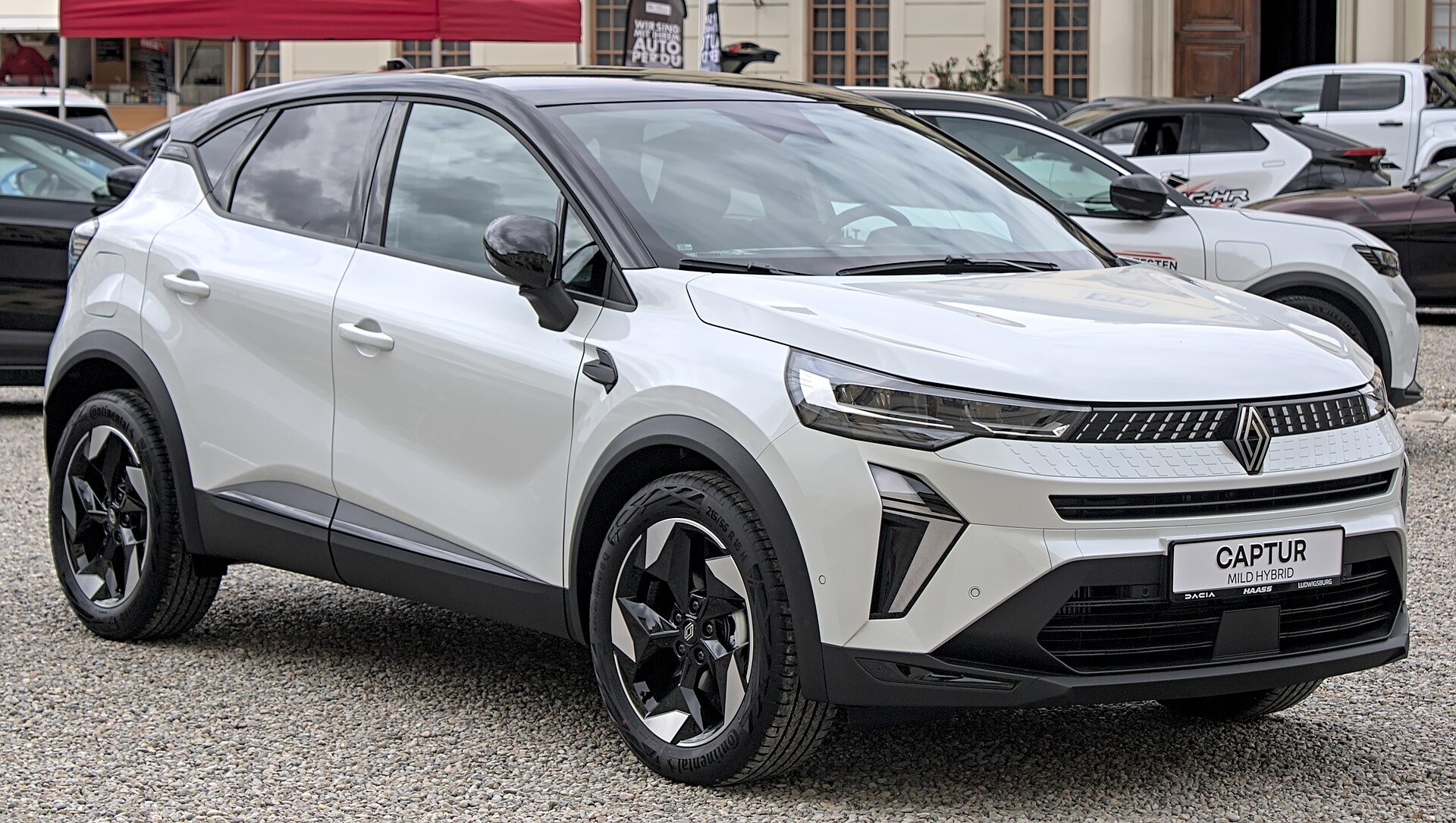
Measure the movable cabin before choosing an engine
The Captur's 16 cm sliding rear bench is a procurement variable, not a decorative feature. With the bench moved, passenger knee room and luggage space trade places; Renault's cited maximum is up to 616 litres for the petrol version and 480 litres for E-Tech by its stated method. Ask the supplier to photograph the bench at both stops and measure the usable floor with the proposed spare-wheel or repair-kit arrangement. Test the buyer's suitcases, child seat or sample cargo dimensions on paper before treating the largest catalogue number as normal everyday capacity.
Keep TCe 115 and E-Tech 160 files apart
The cited UK range includes a TCe 115 gasoline option and E-Tech full hybrid 160. Their transmission logic, underfloor packaging, service skills and parts exposure differ. The quotation must name engine code, transmission, trim, wheel size, production month and source market. For the hybrid, request high-voltage diagnostic information and written battery-warranty territory; for the gasoline car, verify clutch or transmission specification and emissions documentation. Never use one version's luggage, consumption or equipment line to fill a gap in the other version's offer.
Check urban dimensions against the delivery route
The referenced UK dimensions are 4,239 mm long, 1,797 mm wide, 1,575 mm high and 2,639 mm between the axles, with cited ground clearance of 169 mm. Confirm whether mirrors are included in any width used for parking or container planning. Compare turning access, ramp breakover, garage height and tyre availability with the destination. Compact-SUV positioning does not prove suitability for an old-city street, steep residential ramp or rough rural road; those conclusions need the buyer's route dimensions and the offered vehicle's actual wheel and body specification.
Treat the 2019 Euro NCAP record as dated evidence
The available Euro NCAP assessment records 96 percent adult, 83 percent child, 75 percent vulnerable-road-user and 74 percent safety-assist scores, but the rating is expired. Use it to understand the tested generation and equipment, not to claim a universal 2026 result. Match airbags, autonomous braking, lane support and restraint labels on the offered VIN. Check official recalls and campaign completion separately. Destination approval may require additional proof for lighting, glass, emissions, immobiliser, language and left- or right-hand-drive configuration.
Plan hybrid support before valuing fuel savings
An E-Tech purchase is credible only when the destination has technicians, diagnostic access and replacement channels for the hybrid system. Ask for a fault scan, service history, warning-light photograph and battery-related warranty terms. Build a fallback plan for immobilised-vehicle transport. Do not convert brochure economy into a guaranteed saving without route, climate, traffic and fuel assumptions. A buyer with limited hybrid support may prefer TCe even when the hybrid has an attractive test-cycle figure; another buyer with dense urban use and strong service coverage may reach the opposite conclusion.
Compare landed cost with bench position fixed
Suppliers should quote the same Captur powertrain, trim, wheel package and included accessories under the same Incoterm. Separate vehicle price, export documentation, inland haulage, freight, insurance, port charges, tax, compliance work and destination delivery. State the rear-bench position and luggage requirement used in the evaluation so that practicality is not silently changed between offers. Reserve money for tyres, a second key, navigation or language conversion, and any unsupported warranty. Missing identity or hybrid evidence should increase risk allowance rather than disappear inside a single delivered-price number.
Close with a Captur-specific acceptance test
Before payment, reconcile VIN, build plate, engine or hybrid identity, transmission, trim, wheel size, seating labels and option list. Verify both bench travel and seat locking, inspect cargo-floor components, test every driver-assistance warning and obtain recall-search evidence. Keep source links with access dates and mark every market-specific statement. The purchasing result should explain why this exact Captur fits a measured passenger-and-luggage task, not merely repeat that the model is a compact SUV with flexible seating.
Frequently asked questions
Is this definitely one global 2026 Renault Captur specification?
Not from the name alone. A Captur advertised as 2026 must be tied to its VIN, production month and source-market specification, because TCe 115 and E-Tech 160 documentation and equipment can differ.
Which identifiers should be checked before payment?
Reconcile the VIN and build plate with the engine or hybrid-system code, transmission, trim, wheel size and the 16 cm sliding-bench equipment. Photograph both bench end positions and make the invoice name the same configuration.
How should fuel or charging compatibility be verified?
For TCe 115, verify the fuel and emissions labels accepted at destination. For E-Tech 160, add the hybrid diagnostic report, high-voltage service capability and battery-warranty territory; this Captur is not a plug-in, so charging-network claims should not be used to justify it.
Does the cited safety result apply to every imported vehicle?
The cited 2019 Captur result is expired and belongs to the tested generation and safety equipment. Confirm airbags, restraint labels, autonomous braking and lane-support hardware on the offered VIN, then complete the destination approval and recall checks separately.
What belongs in the landed-cost and support check?
Build the Captur worksheet around one fixed powertrain, trim and rear-bench position. Separate export documents, freight, tax and compliance work, then reserve for tyres, a second key, hybrid diagnostics where applicable and warranty gaps.
Sources
- Renault Captur specificationsRenault UK · 2026-08-22
- Renault Captur full hybrid E-TechRenault UK · 2026-08-22
- Renault Captur 2019 safety ratingEuro NCAP · 2026-08-22
- UN Vehicle RegulationsUNECE · 2026-08-22
- Vehicle type approval guidanceUnited Kingdom Vehicle Certification Agency · 2026-08-22
- Australian vehicle recall searchAustralian Department of Infrastructure, Transport, Regional Development, Communications, Sport and the Arts · 2026-08-22