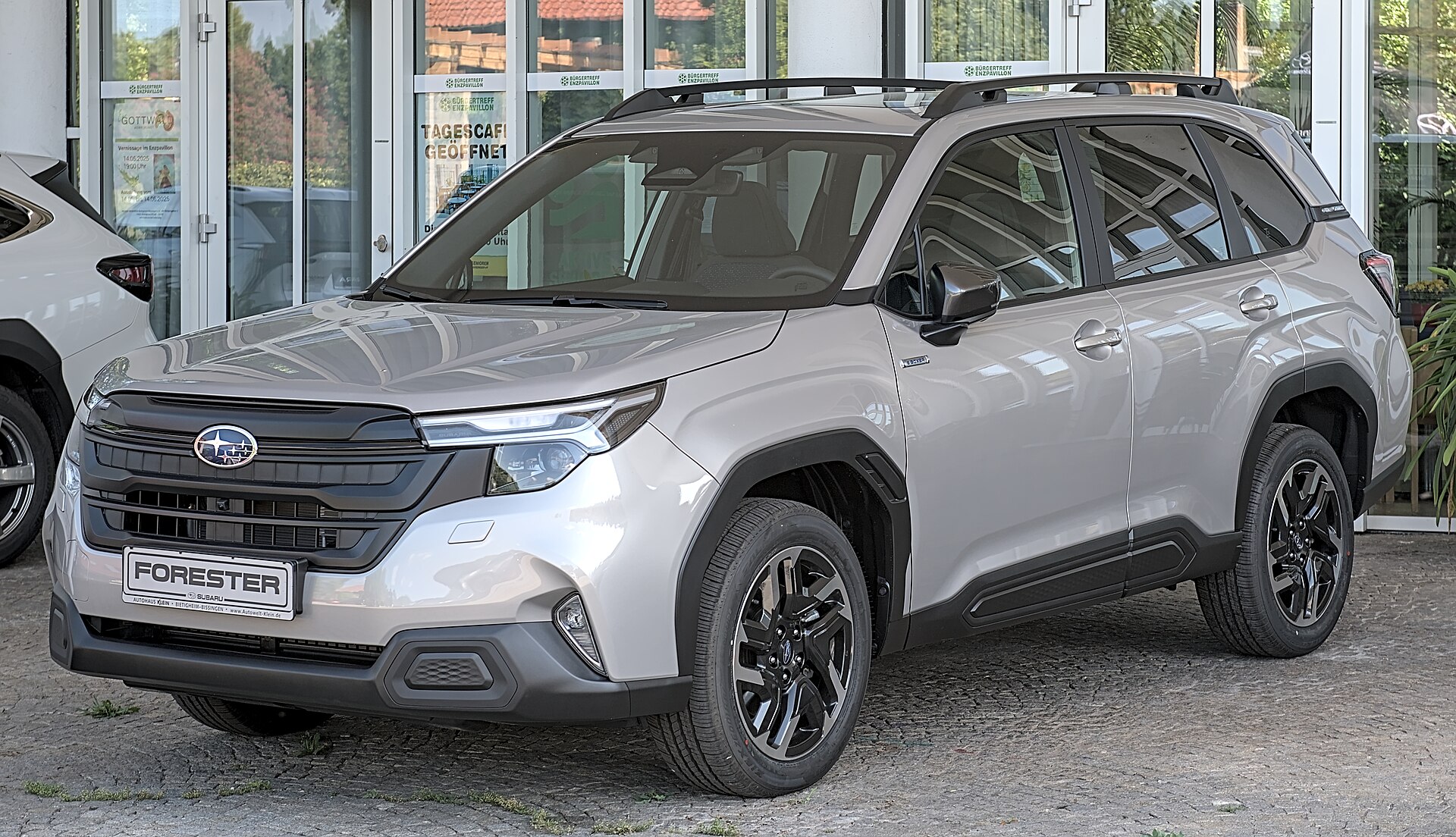
Separate gasoline, Hybrid and Wilderness evidence
The cited US 2026 range includes a 2.5-litre BOXER gasoline system rated at 180 hp and a Hybrid system with an estimated 194 hp, while Wilderness has distinct equipment and some safety exclusions. Put powertrain, trim, production month and market beside the VIN before comparing any specification. Do not transfer hybrid cargo or economy claims to a gasoline car, and do not treat Wilderness clearance or tyres as standard. Buyers in Europe or Asia-Pacific must also confirm whether the offered Forester belongs to the same generation as the US evidence.
Audit the symmetrical-AWD maintenance chain
Standard Symmetrical AWD and Lineartronic CVT make tyre matching, fluid specification and diagnostic access central to the purchase. Record all four tyre models, sizes, tread depths and circumferences plus the spare arrangement. Ask for CVT service history, differential inspection and a fault scan. Price replacement as a four-tyre set where required. Remote-area buyers should identify workshops able to service BOXER packaging, CVT and hybrid high-voltage components. An AWD badge is useful only when the destination can maintain the system without prolonged downtime.
Measure cargo around the hybrid installation
The cited Hybrid figure reaches 69.1 cubic feet, while gasoline and Wilderness figures differ. Verify rear-seat position, cargo floor, spare or repair kit and any battery-related packaging on the offered vehicle. Convert the buyer's luggage, camping equipment or fleet cases into length, width and height requirements. Check roof-system limits separately; interior volume cannot be moved to the roof without respecting dynamic load and accessory ratings. Photograph labels and measurement points so a supplier cannot substitute a different trim after the practical review.
Constrain clearance and trail assumptions
Mainstream US versions cite 8.7 inches of ground clearance, but clearance alone does not define approach geometry, tyre durability, cooling, recovery points or water capability. Build a route profile covering surface, gradient, speed, temperature and service distance. Verify wheel and tyre specification, underbody condition and full-size or temporary spare. Wilderness-specific hardware must be proven from the trim and build sheet. For ordinary road use, heavier off-road equipment may increase tyre and fuel cost without delivering value, so score capability against the actual duty.
Read IIHS and recall evidence by variant
The IIHS page applies selected ratings to 2025-2026 vehicles and states Wilderness exclusions. Match test scope, headlights and crash-prevention equipment to the offered VIN instead of quoting a model-wide result. NHTSA recall communication shows why model year and VIN population matter; obtain official recall-search output and completion receipts. Destination registration remains separate and may involve lamps, glazing, emissions, speed display, security and documentation. Hybrid battery shipping and workshop rules also require local confirmation.
Budget gasoline and hybrid ownership differently
A gasoline ledger should include BOXER service access, CVT, AWD fluids, tyres and emissions components. The Hybrid ledger adds battery diagnostics, high-voltage training, cooling components, warranty territory and immobilised-vehicle transport. Test-cycle economy or range statements should be retained with their method, then replaced by conservative route assumptions in the financial model. Freight, insurance, tax and conversion are separate from both. A buyer should prefer the version with the stronger complete support case, even when another configuration has a more attractive brochure number.
Approve through a tyre-and-powertrain checkpoint
Before payment, reconcile VIN, powertrain, trim, build date, wheel set, option list, cargo arrangement, diagnostic report and service history. Confirm all tyres satisfy the planned AWD circumference policy and inspect the underside for trail damage. For a Hybrid, retain battery and high-voltage evidence; for Wilderness, retain the exact equipment and safety-scope notes. The final procurement statement should identify a serviceable Forester for a measured route, rather than treating gasoline, Hybrid and Wilderness variants as one generic SUV.
Frequently asked questions
Is this definitely one global 2026 Subaru Forester specification?
No. A 2026 Forester listing can refer to materially different gasoline, Hybrid or Wilderness configurations. Release the order only after the VIN and production month identify the source-market variant and its dated Subaru specification.
Which identifiers should be checked before payment?
For a Forester, reconcile the full VIN and model code with the engine or hybrid-system identity, Lineartronic and Symmetrical AWD description, compliance plate, steering side and option sheet. The invoice should name the same variant shown by those records.
How should fuel or charging compatibility be verified?
Read the Forester fuel and emissions labels for the exact VIN before checking destination rules. A gasoline model, the cited Hybrid and Wilderness must not inherit one another’s fuel, emissions, service-fluid or diagnostic requirements.
Does the cited safety result apply to every imported vehicle?
No. The cited IIHS material covers stated 2025–2026 configurations and expressly limits some findings or exclusions, including Wilderness scope. Confirm the tested variant and equipment, then complete the destination’s separate approval process.
What belongs in the landed-cost and support check?
Build the Forester worksheet around its actual powertrain: acquisition and freight, inspection, destination taxes, any compliance work, written warranty territory, VIN recall clearance, AWD/CVT or hybrid service capability, parts access and first-year maintenance.
Sources
- 2026 Forester specifications and trimsSubaru of America · 2026-08-22
- 2026 Forester Hybrid featuresSubaru of America · 2026-08-22
- 2025 Subaru Forester ratingsIIHS · 2026-08-22
- 2026 Forester recall communicationNHTSA · 2026-08-22
- Vehicle type approval guidanceUnited Kingdom Vehicle Certification Agency · 2026-08-22
- Australian vehicle recall searchAustralian Department of Infrastructure, Transport, Regional Development, Communications, Sport and the Arts · 2026-08-22