Global EV sourcing
EV charging connectors: verify the whole system, not the plug shape
A connector that physically fits may still fail to charge, fast-charge or pass a local inspection. Buyers should document the vehicle, charger, electrical supply, software platform and destination rules as one system.
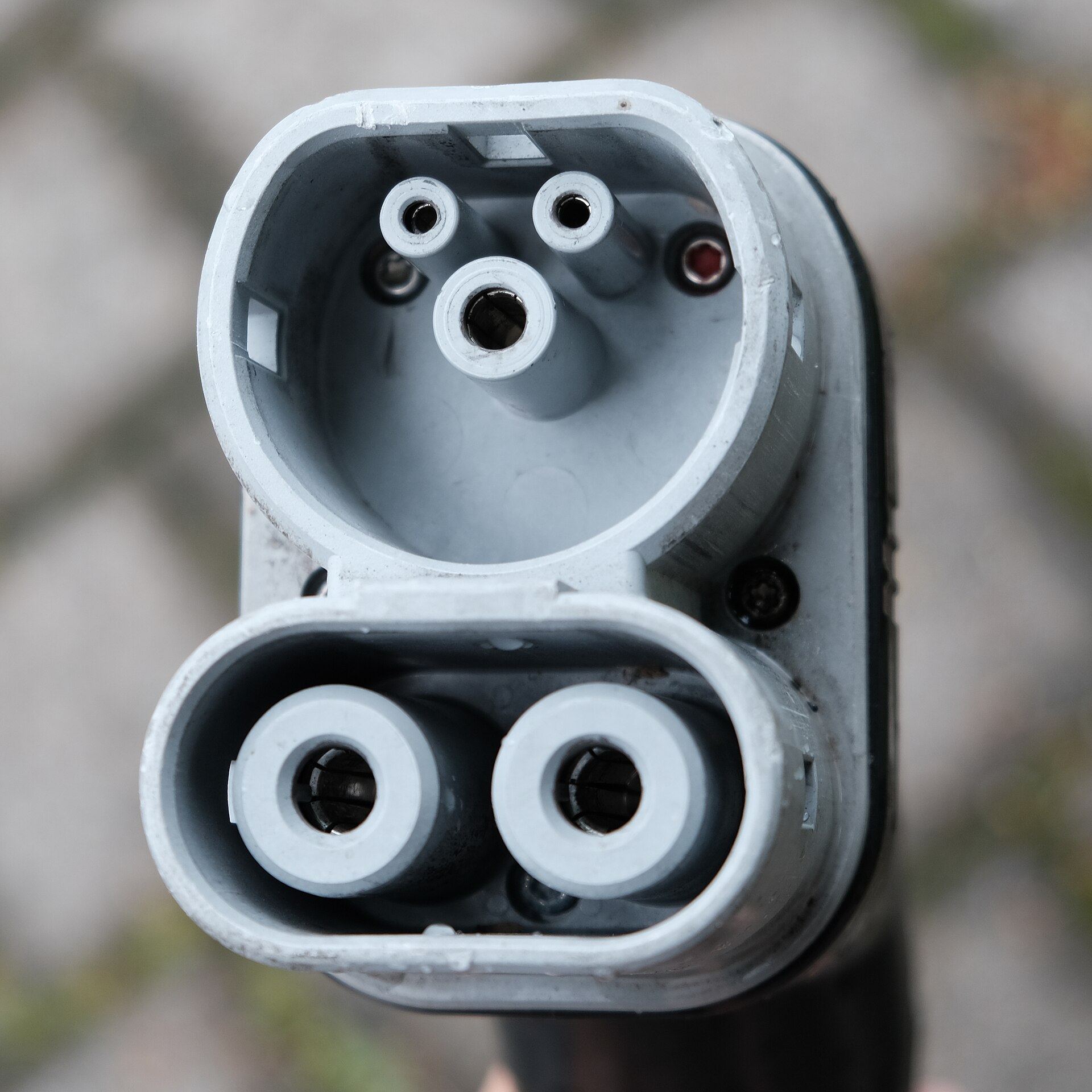
Break the word connector into five separate checks
Charging compatibility is often reduced to the outline of a plug. In practice, it spans the vehicle inlet, cable and coupler, charging equipment, electrical operating limits and communication stack. IEC 62196 addresses safety and dimensional requirements for plugs, connectors and vehicle inlets, while ISO 15118 covers high-level communication between the vehicle and supply equipment. They address different layers, and a mismatch in either layer can stop a session.
A useful request for quotation therefore asks for more than “CCS” or “Type 2.” Require clear photographs of the inlet and vehicle data plate, the relevant pages of the owner's manual, the named AC and DC interfaces, supported phases, voltage and current limits, maximum input, and communication capabilities. Evidence should identify the exact model year, market version and, where possible, the VIN range; a brochure for another regional variant is not proof.
AC and DC charging answer different engineering questions
With AC charging, the vehicle's onboard charger converts the incoming electricity and limits accepted power. With DC fast charging, the station supplies the traction battery more directly, under limits set by battery voltage, temperature, state of charge and the vehicle's charging curve. A familiar inlet does not guarantee a familiar speed. Advertised power is normally an upper boundary, while the lowest limit in the complete chain controls real delivery.
Type 1, Type 2, CCS1, CCS2, CHAdeMO, GB/T and other systems remain in service around the world. Manufacturers may fit different inlets to the same model name for different sales markets. Buyers must compare the actual vehicle inlet with connectors deployed at the intended destinations, then verify that home or depot supplies provide the correct phases, protection and available load. The vehicle badge alone is not a compatibility document.
A mechanical adapter is not a protocol converter
An adapter may rearrange a physical connection, but it does not automatically translate voltage, signalling, locking, temperature supervision or protective logic. This matters most in DC charging, where the vehicle and charger negotiate limits and monitor the session continuously. If their messages or safety states differ, the plug may fit while the session never starts, runs at reduced power or stops with a fault.
Do not accept “we tested it” without a reproducible record. The report should identify vehicle software, charger make and model, ambient temperature, starting state of charge, peak and sustained power, session duration and any diagnostic codes. If an adapter is offered, request its manufacturer's approved application, ratings, test basis and written statement on vehicle warranty. Local legality must be checked separately.
Put destination rules and the site electrical system into the contract
Countries can regulate charger product approval, electrical installation, earthing, residual-current protection, metering, payment access, data interfaces, fire safety and accessibility in different ways. International standards provide a technical foundation, but they do not replace national or municipal permission. A private home, commercial car park, public charging business and fleet depot may also follow different approval paths within one country.
Before purchase, ask a licensed engineer at the destination to review available capacity, fault level, earthing arrangement, surge protection, enclosure rating and cable route. The operating pattern should drive the interface decision. Where public fast charging is sparse, dependable overnight depot charging may be more valuable than a headline peak; vehicles that cross borders need a conservative plan covering the networks on both sides.
Payments and charger backends form another interoperability layer
A car drawing energy does not prove that an operator can monitor, bill and maintain the charger. Chargers often communicate with management platforms through OCPP, but protocol version, optional profiles, vendor extensions and certificate handling affect real interoperability. Plug-and-charge, roaming settlement and bidirectional charging add identity, contract, cybersecurity and electricity-market dependencies that a connector name cannot describe.
Fleet and public-network tenders should contain a separate backend acceptance test. Demonstrate remote start and stop, offline transactions, tariff updates, alarms, firmware management, data export and role-based access. Define who owns the data, how connectivity and cloud fees renew, and whether the hardware can migrate if the platform closes. Otherwise, sound electrical hardware can become a stranded asset behind proprietary software.
Make the purchase decision from an evidence pack
A defensible pack contains inlet and data-plate photographs, manufacturer charging specifications, a charging curve or witnessed session record, a sample of chargers around the operating locations, local installation advice, an interface-and-protocol matrix, and written adapter limitations. Date and version every item and name the party responsible. That discipline matters because model-year changes and software updates can alter a result without changing the model badge.
Write compatibility as an acceptance condition rather than a sales adjective. The contract can require successful AC and DC sessions on agreed equipment, with power, temperature and error information recorded, plus a remedy when the result fails. Unknowns belong in an open-issues register. Search snippets, forum reports and a salesperson's confidence may guide questions, but they are not substitutes for vehicle-specific and destination-specific evidence.
Manage compatibility changes after delivery
Compatibility is not a permanent one-time finding. Vehicle software, charger firmware, backend certificates and public-network equipment all change. A combination that charged successfully can later encounter new negotiation, payment or power behaviour. Keep a configuration baseline for every vehicle and charger, pilot updates on a small group, and compare session-start success, error codes and charging curves after the change. Avoid updating an entire fleet and station estate at once without a rollback plan.
The operating contract should also assign diagnostic responsibilities and access to evidence. The vehicle distributor, charger maker, platform provider and site electrician often see different parts of one failure. Define log retention, remote access, update notices, vulnerability fixes and replacement of discontinued components. Review destination rules, public networks and the vehicle-connector matrix at least annually so the procurement evidence remains an operational control rather than a document that expires on delivery.
Frequently asked questions
Will every CCS2 vehicle work on every CCS2 fast charger?
Not necessarily. The shared mechanical interface is only a prerequisite. Voltage range, protocol implementation, software, charger configuration and local approval can still differ, so the exact vehicle and charger should be tested with a recorded session.
Can one adapter solve every connector mismatch?
No. Adapters do not automatically translate charging protocols, voltage windows or safety controls, and some manufacturers or jurisdictions restrict their use, especially for DC charging. Obtain written applicability and warranty information.
Why is the advertised maximum power rarely sustained?
Real power follows the lowest limit among the vehicle, charger, battery temperature, state of charge, cable and grid connection. A peak may last briefly, which is why a full charging curve is more useful than one number.
Which evidence matters most before importing?
Start with manufacturer charging specifications for the exact variant, clear inlet and data-plate photographs, and destination-authority or licensed-engineer confirmation of the interface and installation requirements.
Does OCPP compatibility prove the car can charge?
No. OCPP mainly connects the charger to its management platform. The vehicle-to-charger connector and communication layer must be verified separately.
Sources
- IEC 62196-1:2022 — General requirements for EV plugs, socket-outlets, connectors and inletsInternational Electrotechnical Commission · 2026-07-13
- ISO 15118-1:2019 — Vehicle-to-grid communication interfaceInternational Organization for Standardization · 2026-07-13
- Electric vehicle charging — Global EV Outlook 2025International Energy Agency · 2026-07-13
- Connectors worldwide — CharIN white paperCharging Interface Initiative · 2026-07-13
- Open Charge Point ProtocolOpen Charge Alliance · 2026-07-13
- J3400_202409 North American Charging System (NACS) for Electric VehiclesSAE International · 2026-08-09