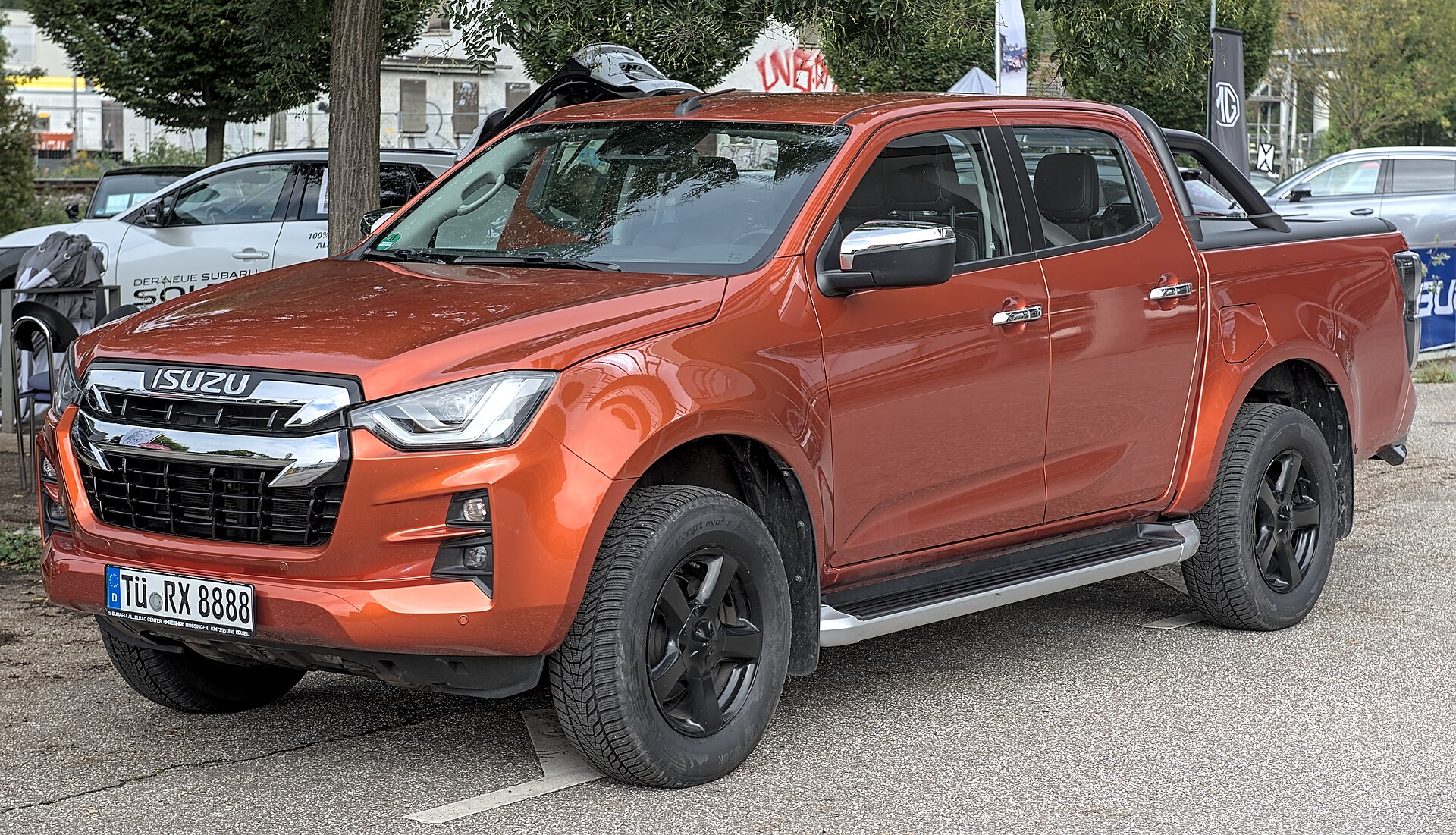
The badge is the start of identification, not the end
A search for “2026 Isuzu D-Max” reaches several legitimate but incompatible products. Isuzu UK's January 2026 document lists a 1.9-liter diesel Utility, DL20, DL40 and V-Cross range. Its May 2026 material adds a separately priced battery-electric range. Thai distributor pages current in 2026 advertise 2.2- and 3.0-liter diesels, while the Australian specification sheet issued on 1 May 2026 is explicitly labeled 25.5MY. Those dates cannot be collapsed into one world model year.
Begin the file with the full VIN, build month, selling country, steering side, cab and body type, trim, engine or motor code, transmission and driven wheels. Photograph the VIN stamping, manufacturer plate, emissions or conformity label and, where fitted, battery plate. Reconcile them with title, invoice and official market literature. A translated advertisement, grille design or trim badge is not enough to establish model year or mechanical specification.
Keep each powertrain inside its home market
The current UK diesel table gives 164 PS at 3,600 rpm and 360 Nm at 2,000-2,500 rpm from a 1.9-liter engine. Thailand's 2026 V-Cross evidence instead identifies a 2.2 Ddi MAXFORCE with 163 PS, 400 Nm and an eight-speed automatic, and Thai range pages also show selected 3.0-liter 190 PS derivatives. Similar power figures do not make the engines, emissions systems, gearboxes or service parts interchangeable.
The UK D-Max EV needs its own procurement worksheet. The current eDL40 page specifies a 66.9 kWh battery, dual motors producing 149.3 kW and 347.6 Nm, full-time 4x4 and a 263 km WLTP range. Earlier promotional material used different pre-launch output figures, so the dated production page should govern and the VIN build specification should settle any remaining conflict. Record connector type, charging limits, battery report and destination support before payment.
Payload is a calculation tied to one completed truck
Isuzu UK's Utility table illustrates why a single headline is dangerous. Listed payload ranges from 1,100 kg for one double cab to 1,205 kg for a 4x4 single cab. V-Cross is listed at 1,105 kg with the manual and 1,085 kg with the automatic. These are standard-vehicle calculations from gross vehicle weight minus kerb weight; a canopy, tray, winch, towbar, underbody protection, occupants and tools all consume the same allowance.
Ask for photographs of the gross vehicle, front axle, rear axle and gross train mass plates, then obtain a recent weighbridge ticket for the vehicle in its sale condition. Subtract actual kerb mass from the lawful gross mass and check each axle separately. For a cab-chassis, require the body builder's completion certificate and final mass distribution. Never use a Thai engine brochure or an Australian grade name to fill a missing UK payload field.
Towing claims need five matching limits
The UK Utility page lists 2,500 kg braked towing for the 4x2 single cab and 3,500 kg for the listed 4x4 single, extended and double cabs. It also gives different gross train and nose-weight limits. V-Cross manual and automatic reach 3,500 kg in the UK table, but that does not prove another country's tow rating or that a fitted towbar, coupling and trailer are approved for the same mass.
Before contracting for towing work, match the vehicle plate, manufacturer tow limit, gross train mass, towbar label and destination licence rule. Add trailer nose weight, payload, passengers and accessories to an axle-loading calculation. Ask whether the truck has previously towed near its maximum and inspect the chassis, rear springs, differential, cooling system, brakes and transmission. A 3.5-tonne marketing line is not a substitute for this evidence chain.
Read safety scores with the applicability table open
ANCAP says its 2022 rating applies to listed vehicles built from July 2022 and excludes Blade; it explains that the updated trucks received a revised driver knee airbag and instrument panel. Euro NCAP's 2022 result identifies a 1.9-liter diesel crew cab and shows which 4x2 or 4x4, left- or right-hand-drive variants are covered. Neither page establishes a rating for the UK electric D-Max or every Thai commercial body.
Verify the actual truck's airbags, camera and radar hardware, tyre specification and driver-assistance menus rather than copying a safety-feature list. Assistance systems have operating limits and may differ by trim or calibration. Run a current recall check in the source country and obtain dealer invoices showing completed remedies. Imported owners may not receive a letter when manufacturer records do not contain their current address, so repeat the VIN check before shipment.
Build the offer around documents and landed use
A complete offer should separate vehicle price, tax treatment, inspection, inland transport, port fees, ocean freight, insurance, destination duty, homologation work, registration, storage and contingency. UK commercial on-the-road prices include local items that may not benefit an exporter; Thai and Australian advertised prices follow different tax systems. Preserve currency, quote date, Incoterm, title transfer point and refund conditions instead of comparing converted headline prices.
The purchase file should contain seller authority, finance-release evidence, title history, VIN photographs, build and conformity labels, service history, diagnostic scan, recall result, plated masses, weighbridge ticket and condition images of chassis, bed and tow equipment. EV buyers also need battery health and charging compatibility; diesel buyers need emissions-system and fuel-quality checks. Pause the deal if identity, legal export, destination registration or total cost cannot be independently verified.
Frequently asked questions
Is every D-Max offered during 2026 a 2026 model-year truck?
No. The reviewed UK documents are dated in 2026, Thailand has a local 2026 range, and Australia's May 2026 specification document remains labeled 25.5MY. Verify the VIN, build plate, title and source-market model convention.
Can I quote one D-Max engine specification worldwide?
No. The UK diesel range uses a 1.9-liter engine, while current Thai pages show selected 2.2- and 3.0-liter diesels; the UK also has a separate electric model. Keep each output, gearbox and emissions claim with its market.
Does every D-Max tow 3.5 tonnes?
No. The UK table lists only 2,500 kg for the 4x2 single cab and 3,500 kg for specified 4x4 versions. The actual plate, gross train mass, towbar, trailer, licence and destination rules all have to agree.
Is the advertised payload still available after accessories are fitted?
Usually not in full. Payload is gross vehicle weight minus actual kerb mass. A canopy, tray, towbar, winch, occupants and equipment consume payload and can overload an axle before the total mass limit is reached.
What evidence should be complete before an export deposit is paid?
Require verified VIN and title, seller authority, source-market specification, plated masses, condition and diagnostic evidence, recall status, destination eligibility, itemized landed cost and written terms for inspection, rejection and refund.
Sources
- The New Isuzu D-Max range price list, January 2026Isuzu (UK) Limited · 2026-07-26
- Isuzu D-Max Utility dimension and specificationIsuzu (UK) Limited · 2026-07-26
- Isuzu D-Max V-Cross dimension and specificationIsuzu (UK) Limited · 2026-07-26
- Isuzu D-Max eDL40 dimension and specificationIsuzu (UK) Limited · 2026-07-26
- D-Max Range EV price list, May 2026Isuzu (UK) Limited · 2026-07-26
- D-Max global product pageIsuzu Motors Limited · 2026-07-26
- New Isuzu V-Cross 4x4 with 2.2 Ddi MAXFORCETri Petch Isuzu Sales Company Limited · 2026-07-26
- New Isuzu D-Max four-door rangeTri Petch Isuzu Sales Company Limited · 2026-07-26
- 25.5MY Isuzu D-Max vehicle specificationsIsuzu UTE Australia · 2026-07-26
- Isuzu D-Max safety rating and reportANCAP Safety · 2026-07-26
- Isuzu D-Max Crew Cab 2022 safety ratingEuro NCAP · 2026-07-26
- Vehicle recalls and faultsUK Driver and Vehicle Standards Agency · 2026-07-26