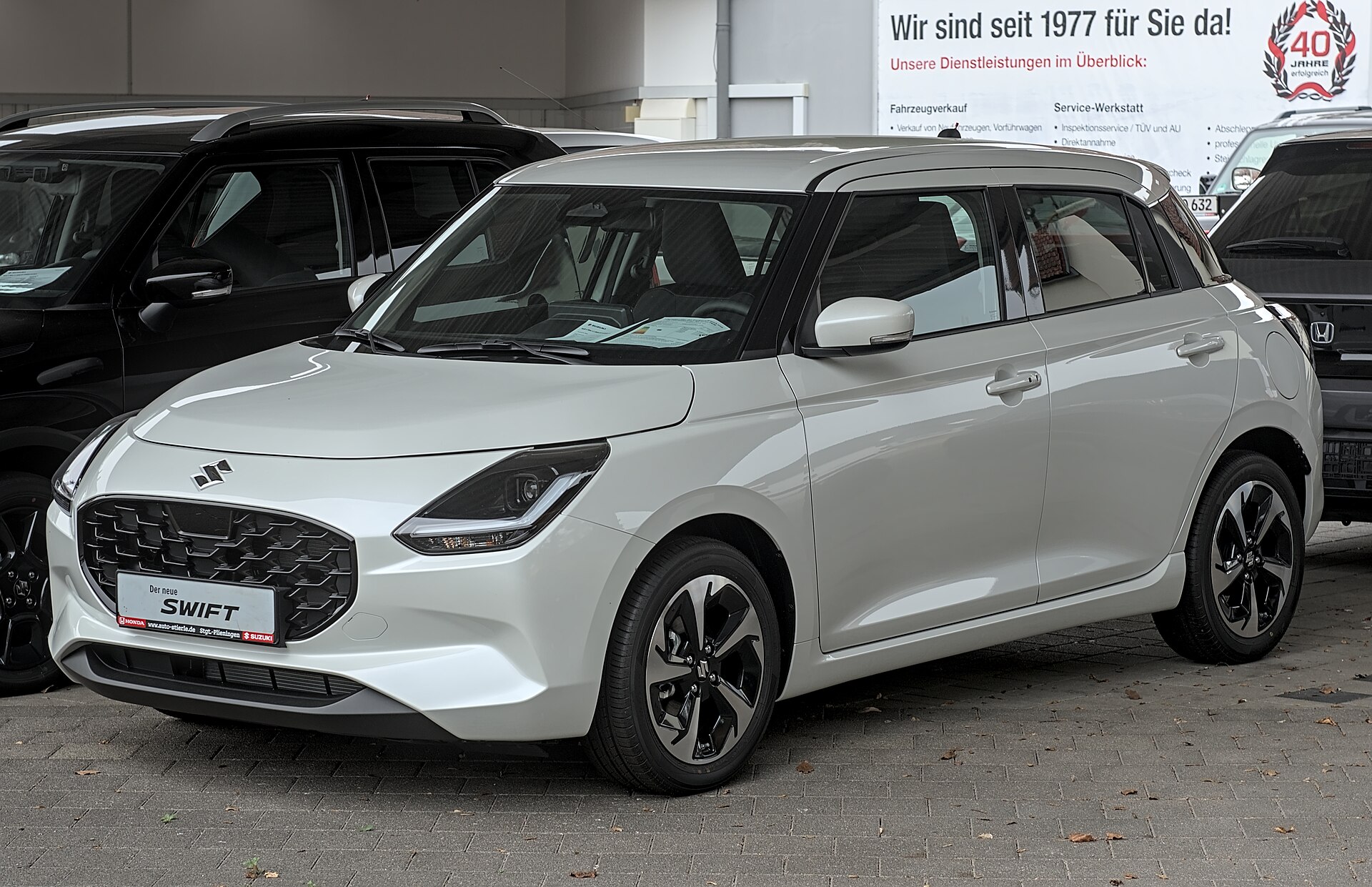
Locate the Swift within its plant and VIN range
The current Swift is a five-door hatchback built for multiple markets, but safety equipment and rating scope can change by production origin and date. Record VIN, plant, build month, destination code and trim before using any specification. ANCAP material identifies an Australasian safety update near an approximate VIN 250001 boundary, so the supplier must show which side of that boundary the offered vehicle occupies. A 2026 registration or advertisement date cannot substitute for production evidence, especially when vehicles from different factories share exterior styling.
Confirm the Z12E driveline combination
The cited technical material identifies the 1.2-litre Z12E at 60.9 kW and 111.8 Nm, with 2WD or ALLGRIP AUTO and 5-speed manual or CVT depending on market. SHVS mild hybrid availability also varies. Record engine, transmission, drive and hybrid-system codes on the quotation. Do not assign a CVT economy line to the manual or an ALLGRIP feature to a 2WD car. Ask for underbody, transmission control and battery-area photographs where the sales sheet is incomplete.
Evaluate light weight without inventing durability
Swift's compact dimensions of roughly 3,860 by 1,735 by 1,495 mm and 2,450 mm wheelbase support an urban-space analysis, not a blanket claim about strength or rough-road endurance. Map parking width, ramp angle, pothole exposure, passenger load and highway speed. Check tyre size, load index, spare provision and local availability. A light hatchback can be efficient and easy to ship, but those benefits must be balanced against the destination's surface conditions, crosswinds and repair network using inspection evidence rather than assumptions.
Measure the 265-litre cargo claim
The cited luggage figure is about 265 litres with the rear seats raised, subject to method and trim. Request floor length, width between arches, load height, rear-seat split and spare-wheel photographs. Test grocery boxes, cabin bags or delivery crates against those dimensions. If passengers require all rear seats, do not use folded-seat capacity in the commercial case. Compact exterior size and five seats can be valuable for dense cities, yet a buyer should prove that everyday luggage fits before accepting reduced operating cost as the decisive advantage.
Keep Euro NCAP and ANCAP findings separate
Euro NCAP's 2024 assessment records 67 percent adult, 65 percent child, 76 percent vulnerable-road-user and 62 percent safety-assist scores for its listed 1.2L GL+ scope. ANCAP documents a build-date and approximate VIN change for updated Australasian specification. These are not interchangeable ratings. Match safety sensors, restraint labels and assistance functions to the vehicle, scan for faults and check official recalls. Destination compliance for lamps, glazing, emissions, immobiliser and documentation remains an additional local process.
Price ALLGRIP and SHVS support explicitly
ALLGRIP adds driveline parts and tyre-matching considerations; SHVS adds a mild-hybrid battery and related electrical components. Ask local workshops whether they can diagnose each system and obtain part numbers for common service items. A feature with no practical support should receive a risk reserve, not an assumed resale premium. Compare manual, CVT, 2WD, ALLGRIP and SHVS configurations using the buyer's traffic, gradient, climate and annual-distance profile. Keep official test-cycle figures attached to their exact variant and avoid guaranteeing real-world consumption.
Release a Swift against a VIN-bound checklist
The closing file should reconcile VIN, plant, production date, Z12E identity, transmission, drive system, SHVS status, trim, wheels, safety equipment and recall result. Inspect cargo layout, all keys, diagnostic warnings, underside and service history. Confirm export title and destination registration evidence before shipping. The approval note must state whether the offered vehicle falls within the relevant safety specification and whether local support exists for its driveline. This is more useful than ranking every Swift carrying a 2026 label as the same car.
Frequently asked questions
Is this definitely one global 2026 Suzuki Swift specification?
No. A “2026 Swift” search result does not establish one worldwide specification. Identify the plant, source market, build date and VIN range first, especially where the Australasian safety update changes near the cited VIN boundary.
Which identifiers should be checked before payment?
For a Swift, match the complete VIN and model code to the Z12E engine record, 2WD or ALLGRIP AUTO driveline, 5MT or CVT, steering side, compliance plate and fitted safety package. The order sheet must describe that exact combination.
How should fuel or charging compatibility be verified?
Verify fuel and emissions from the offered Swift’s labels and homologation papers. SHVS availability, transmission and driveline differ by market; assess the destination’s fuel, emissions and diagnostic support for the identified combination rather than a generic Swift.
Does the cited safety result apply to every imported vehicle?
No. Euro NCAP’s 2024 findings and the cited ANCAP scope use different market and validity boundaries, with the ANCAP change near VIN 250001. Apply only the result that matches the vehicle’s VIN range, equipment and market.
What belongs in the landed-cost and support check?
Calculate the Swift around its small-car use case: acquisition and freight, inspection, destination taxes, compliance work, written warranty territory, VIN recall status, support for Z12E/SHVS and the selected transmission, parts availability and first-year servicing.
Sources
- Suzuki Swift global model pageSuzuki Motor Corporation · 2026-08-22
- Swift European press technical dataSuzuki Motor Corporation · 2026-08-22
- Suzuki Swift 2024 safety assessmentEuro NCAP · 2026-08-22
- Suzuki Swift safety-rating updateANCAP · 2026-08-22
- Vehicle type approval guidanceUnited Kingdom Vehicle Certification Agency · 2026-08-22
- Australian vehicle recall searchAustralian Department of Infrastructure, Transport, Regional Development, Communications, Sport and the Arts · 2026-08-22