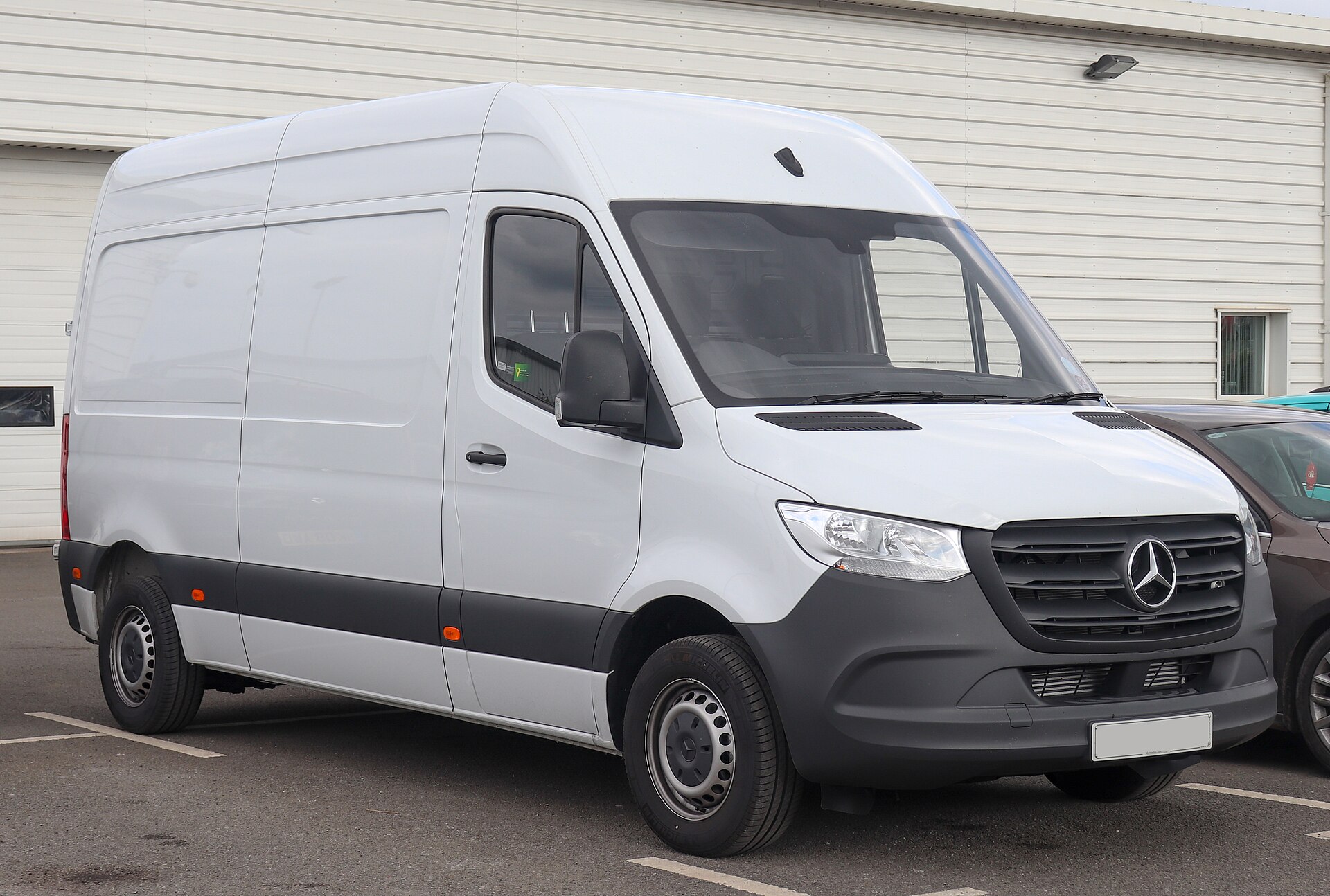
Start with identity, not the 2026 search label
Mercedes-Benz sells Sprinter as a configurable commercial-vehicle family: cargo or panel van, crew or passenger body, and cab chassis, with several lengths, roof heights and gross-weight classes. eSprinter adds a battery-electric branch. A listing that says only ‘2026 Sprinter’ therefore leaves the decisive facts unresolved. Before pricing, record the VIN, production month, sales market, manufacturer body code, wheelbase, roof, axle ratings, original seating and the completed body's legal classification.
The sources accessed on 28 July 2026 describe different slices of that family. The US page explicitly labels its current Cargo Van lineup 2026; the Mexican page describes model year 2025; UK and Australian pages describe their current local ranges without making every figure a universal model-year promise. This guide preserves those labels. A newer registration date, a familiar badge or a seller's translated advertisement cannot move a specification from one market to another.
Separate diesel, historical gasoline and battery electric hardware
For the US 2026 Cargo Van, the verified combustion anchor is the 1,950 cc four-cylinder diesel. Standard output is 170 hp and 295 lb-ft; high output is 211 hp and 332 lb-ft, with 9G-TRONIC. Rear-wheel drive and available all-wheel-drive combinations vary by derivative, so an output figure does not prove the driven axles. Ask for the factory data card and emissions label, then confirm that engine, transmission and drive entries agree with the VIN before ordering parts or estimating fuel cost.
The 2.0 L turbo gasoline figure of 188 hp and 258 lb-ft belongs to Mercedes-Benz Vans USA's model-year-2022 brochure. It is useful for identifying older stock, but it is not evidence that a US 2026 vehicle is gasoline-powered. eSprinter is different again: no combustion engine, diesel tank or gasoline emissions system should appear in its specification. The US electric page lists rear-wheel drive, 100 or 150 kW motor and 81 or 113 kWh usable battery.
Keep length, roof and payload on the same configuration row
A clean US example shows why configuration binding matters. The 2026 WORKER Cargo Van 2500 with 144-inch wheelbase and standard roof is listed at 234 inches long and 100 inches high, with 4,211 lb payload, 319.0 cu ft cargo volume, 9,050 lb GVWR and 5,000 lb maximum towing. Those values form one row. The US page also contains longer, higher and heavier derivatives with different payload, volume and towing figures; taking the best number from each row would describe a van that does not exist.
Metric-market maxima are equally local. The UK combustion panel van offers 5,930, 6,970 or 7,370 mm lengths, two heights, floor length up to 4,810 mm and payload up to 2,479 kg at up to 5,000 kg GVW. Australia publishes floor length up to 4.81 m, payload up to 3,090 kg and GVM up to 5,500 kg. Mexico's model-year-2025 page lists up to 15.5 m3 and 3,068 kg. Different homologation ranges explain the differences; none should overwrite a vehicle's plates.
Read eSprinter range and charging in their test context
The US eSprinter page pairs the 81 and 113 kWh usable batteries with stated maximum ranges of 150 and 206 miles. It also lists 144- or 170-inch wheelbase, 239.7- to 280-inch overall length, 319.0-488.1 cu ft cargo volume and a 9,370 lb GVWR. The published AC and DC times depend on battery and charging power, including 9.6 kW AC and up to 110 kW DC examples. A buyer should capture the battery code, onboard charger, inlet type and charging curve for the exact van.
The UK eSprinter page uses combined WLTP and states 161-272 miles (259-438 km) for 81-113 kWh, together with 5,900 or 7,000 mm lengths, normal or high roof, up to 4,400 mm load floor, 14 m3 load volume, 4,250 kg gross mass and 2,000 kg towing. Do not compare the UK range endpoints directly with the US numbers as though they came from one test. Route payload, temperature, speed, auxiliary loads and charger reliability need a local duty-cycle trial.
Interpret safety grades and recalls precisely
Euro NCAP gives the listed European N1 diesel Sprinter five stars under its 2025 commercial-van assessment, with 75% for Safe Driving, 89% for Crash Avoidance and 80% for Post Crash Safety. ANCAP separately gives applicable Australian Sprinter petrol/diesel vehicles and eSprinter electric vehicles a 2024 Platinum commercial-van grading at 89%. ANCAP explains that this comparison concentrates on collision-avoidance systems and does not replace its destructive-crash star programme. Build date, fitted sensors and protocol must accompany any rating claim.
Recalls are narrower than a model name. NHTSA campaign 25V712 concerns 16 US model-year-2025 Sprinter 2500 vehicles with a radar-board risk; Transport Canada 2025076 concerns certain model-year-2024 eSprinters with a rear-axle electric-drivetrain weld issue. Neither notice proves that another VIN is affected or clear. Run current government and manufacturer VIN searches immediately before payment and again before shipment, then obtain invoices showing that every open remedy was completed.
Build a landed-cost and compliance file before purchase
For a combustion Sprinter, collect the VIN data card, title, production label, engine family, emissions label, axle and gross-weight plates, service history, recall clearance and conversion approval. Verify diesel after-treatment, fuel quality compatibility, steering side, lamps, speedometer units, tachograph or speed-limiter duties, licence class and local inspection rules. Weigh the finished van by axle with its permanent shelving, refrigeration, lift, seats and spare wheel; brochure payload is not remaining legal payload after conversion.
For eSprinter, add battery capacity and health evidence, high-voltage warranty start date, charging inlet and onboard-charger codes, DC charge capability, thermal-management diagnostics and destination charging support. Quote freight from actual overall length and height, not the shortest brochure body. The purchase decision should compare usable payload, route energy or fuel, insurance, tyres, scheduled maintenance, charging downtime, emissions-system risk, parts lead time and resale eligibility under one clearly identified configuration.
Frequently asked questions
Is a 2026 Mercedes-Benz Sprinter available with gasoline?
The verified US 2026 Cargo Van page in this evidence set lists the 1,950 cc diesel. The 188 hp 2.0 L turbo gasoline specification is from an official model-year-2022 brochure and must be treated as historical. Require a 2026 factory build sheet and VIN data card before calling any current vehicle gasoline-powered.
Can I use the 4,211 lb payload for every Sprinter?
No. It belongs to the US 2026 WORKER Cargo Van 2500 with 144-inch wheelbase and standard roof in the cited row. Longer, higher, heavier, AWD, passenger, crew, chassis and converted vehicles have different curb mass, axle limits and legal payload, so the finished vehicle must be weighed.
Are the US and UK eSprinter range figures directly comparable?
No. The US page states 150 or 206 miles for its 81 or 113 kWh versions, while the UK page states 161-272 miles under combined WLTP. Keep the source test method, battery, body and options with each number, then validate the proposed route under local load, weather and charging conditions.
Does five-star Euro NCAP or Platinum ANCAP cover every imported Sprinter?
No. Euro NCAP's 2025 result is tied to its listed European N1 diesel test scope, while ANCAP's 2024 Platinum grades apply to defined Australian combustion and electric variants and focus on collision avoidance. Confirm build date, market, sensors and standard equipment for the exact VIN.
What should be checked before paying for an export Sprinter?
Match the VIN, build sheet, title, production and emissions labels, body and conversion approvals, axle/GVW plates, exact dimensions, finished axle weights and recall status. For diesel verify after-treatment support; for eSprinter also verify battery code, health, warranty, inlet, onboard charger and local DC compatibility.
Sources
- 2026 Sprinter Cargo VanMercedes-Benz Vans USA · 2026-07-28
- eSprinterMercedes-Benz Vans USA · 2026-07-28
- Sprinter Panel VanMercedes-Benz Vans UK · 2026-07-28
- eSprinter Panel VanMercedes-Benz Vans UK · 2026-07-28
- Sprinter Panel Van — dimensions and equipmentMercedes-Benz Vans Australia/Pacific · 2026-07-28
- Sprinter Cargo VanMercedes-Benz Vans Mexico · 2026-07-28
- 2022 Mercedes-Benz Sprinter brochureMercedes-Benz Vans USA · 2026-07-28
- Mercedes-Benz Sprinter commercial van assessmentEuro NCAP · 2026-07-28
- Mercedes-Benz Sprinter safety gradingANCAP Safety · 2026-07-28
- Mercedes-Benz eSprinter safety gradingANCAP Safety · 2026-07-28
- NHTSA campaign 25V712 — loss of automatic emergency brakingNational Highway Traffic Safety Administration · 2026-07-28
- Transport Canada Recall 2025076 — Mercedes-Benz eSprinterTransport Canada · 2026-07-28
- Annual Certification Data for Vehicles, Engines, and EquipmentUnited States Environmental Protection Agency · 2026-07-28